
Yes, an hourly advertising auction is one of the fastest, cheapest ways for a founder to find out whether a channel sends anyone at all. Claim an empty slot for free or place a small opening bid, then watch the published clicks and click-through rate for that hour. On BidSurvivor, that first look at real traffic costs nothing and takes about an hour to see.
TL;DR:
- Claiming an empty hour costs nothing, allowing quick, low-risk testing of whether your ad creative generates clicks before investing money.
- Bids should be minimal to secure a slot and raised gradually if outbid, preventing overspending on unproven timings.
- Testing at different daily hours helps identify peak traffic windows, with 8 a.m. and lunch hours often outperforming subjective guesses.
- Use a dedicated short link or UTM for each slot to attribute clicks and conversions accurately, avoiding false signals from low-volume data.
- Multiple runs of the best-performing hour validate results, as one hour alone provides only a limited data sample and potential for misleading conclusions.
Table of Contents
- How an Hourly Advertising Auction Actually Works
- Why Founders Should Bother With Hourly Bidding at All
- How to Run a Low-Cost Test in Your First 72 Hours
- Getting the Creative and Measurement Right
- What I've Learned Watching Founders Bid on Hourly Slots
- Start Your First Hourly Test on BidSurvivor
- Sources
- FAQ
How an Hourly Advertising Auction Actually Works
Most people picture an advertising auction as something with dashboards, targeting menus, and a minimum spend that scares off anyone testing an idea on a Tuesday afternoon. An hourly advertising auction strips that down to one thing: a single slot, for a single hour, showing your logo, a one-line description, and a link. That's the whole unit you're bidding on.
The mechanics are simple and that's the point. A slot sits open until someone claims it. Once claimed, any other brand can outbid the current holder by paying more, and the higher bid takes the slot immediately, often before the hour even starts. There's no waiting for an ad review or a campaign to "learn." You bid, you win, your logo goes live.
What makes this different from a typical online ad auction is transparency. Every brand's click numbers are visible before you bid on anything, so you're not gambling blind on whether a given hour or board actually converts attention into clicks.
A few structural things to know going in:
- Each slot lasts exactly one hour, with no carryover or rollover.
- The first bid on an empty hour is free and needs no account or card.
- There's no targeting, no retargeting, and no pixel dropped in the slot. This measures visibility and landing page pull, not audience profiling.
- Slots can be booked up to a week ahead, which lets you plan around expected traffic patterns instead of scrambling last minute.
That last constraint, no tracking pixel, trips people up. You're not testing "does this audience respond to my ad." You're testing "does anyone click this, and does the page I sent them to do its job."
Why Founders Should Bother With Hourly Bidding at All
The case for this over a traditional ad platform comes down to speed and cost of failure. A normal digital ad bidding setup asks you to commit budget for days before you learn anything useful. An hourly slot answers the same question in sixty minutes, at a fraction of the risk.
Judge results in this order: clicks and CTR first, then conversion rate, then cost per conversion. Clicks tell you if the placement gets seen at all. CTR tells you if your one-line description earns a look. Conversion rate only matters once you've cleared the first bar, because a slot with plenty of clicks and no conversions is a landing page problem, not an ad auction problem.
Pro Tip: Claim a free empty hour before you spend a dollar bidding. It's the cheapest way to see if your creative resonates before money is on the line.
Timing concentration pays off elsewhere in advertising too. Businesses that shift bids by 15 to 50 percent into their known peak windows have seen traffic gains of roughly 30 percent in some campaigns, which is the same logic behind chasing your own "golden hours" instead of spreading bids evenly across the day.
Skip this approach if you need deep retargeting, granular audience segmentation, or multi-touch attribution across a long funnel. An hourly advertising auction tells you whether a door opens. It won't tell you who's behind it.
How to Run a Low-Cost Test in Your First 72 Hours
Before you touch the auction board, get three things ready: a landing page that's live and loads fast, one KPI you're watching (clicks, not vibes), and a unique short link or UTM tag for each hour you plan to test. Skip this prep and you'll have clicks with no way to trace what happened next.
- Pick three candidate hours. Morning commute, lunch, and evening wind down usually behave differently. Don't guess. If you have any existing traffic data, use it to shortlist which hours might already lean toward your audience, since assuming every hour performs equally is the single most common mistake founders make here.
- Claim or bid. If the hour is empty, claim it free. If it's held, place a minimal bid, just enough to take it, not enough to overpay for a test.
- Run each hour once. Let the slot play out and record the published click count and CTR. Repeat your best-performing hour a second time before drawing conclusions from one data point.
- Set a stop-loss. Decide your ceiling before you start bidding, not while you're mid-auction watching the price climb.
- Raise in small increments if outbid. Jumping straight to a high number to "win" defeats the purpose of a cheap test. Nudge up, and walk away once the cost no longer makes sense for a one-hour experiment.
- Decide with a threshold, not a feeling. If an hour produces meaningfully more clicks than the others, that's your signal to reallocate future budget there. If all three hours perform similarly, your creative, not your timing, is probably the bottleneck.
This mirrors a common hybrid approach in paid media: run broadly first, then narrow once the data shows which windows actually produce results. You're just doing it in hours instead of weeks, and at auction prices instead of agency retainers.
Getting the Creative and Measurement Right
A one-hour slot gives you almost no room for a cluttered pitch. Your one-line description needs to say what you do and who it's for in a single breath, paired with a CTA that tells someone exactly what happens when they click. A high-contrast logo helps too. Slots get scanned in seconds, not studied.
On measurement, lean on what's actually available to you:
- The board's published click count for that hour, which you can check without any tooling.
- A dedicated short link or UTM tag per hour, so you know exactly which slot sent which visitor.
- A lightweight server-side conversion event on your landing page, even something as basic as a signup confirmation.
Pro Tip: Watch CTR before you touch conversion numbers. A low-click hour with a single conversion tells you nothing reliable. A high-click hour with zero conversions tells you your landing page needs work, not your bidding strategy.
Resist the urge to declare victory or defeat off one low-volume hour. One hour of traffic is a sample, not a verdict. If you want independent confirmation that a slot actually delivered impressions rather than trusting the dashboard alone, tools built for ad verification can confirm a campaign ran as claimed. Once you've got a few hours of data, iterate the creative, shift budget toward whichever hour keeps winning, and retest the loser hours later. Traffic patterns shift, and yesterday's dead hour might not stay dead.
What I've Learned Watching Founders Bid on Hourly Slots
Running the board at BidSurvivor for a while teaches you patterns fast, and most of them contradict what founders expect going in.
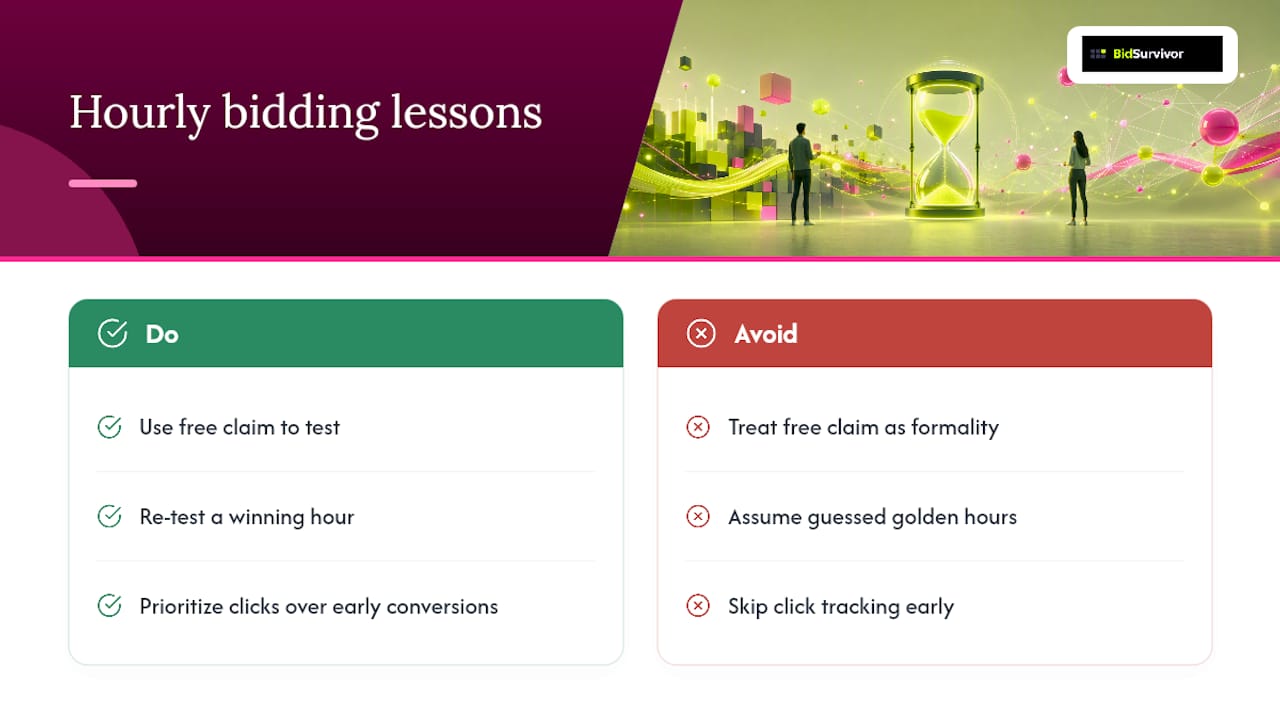
First: the free claim on an empty hour is underused. People treat it as a formality before "real" bidding starts, when it's actually the best low-stakes test available. Second: golden hours are real, but they're rarely the ones people guess. A founder convinced their audience is "night owls" often finds their best CTR sitting at 8 a.m. Third: clicks before conversions, always. A brand that skips straight to conversion tracking on hour one usually ends up chasing noise instead of signal.
Picture a small SaaS tool testing three hours over two days. Hour one gets six clicks and no signups. Hour two gets nineteen clicks and two signups. The founder doesn't scale hour two yet, they run it again first, confirm the pattern holds, then commit the next week's budget there. That patience is the whole game.
— Sienna
Start Your First Hourly Test on BidSurvivor
BidSurvivor turns "should we try this channel" into an answer you get within the hour, not the quarter. There's no minimum spend, no subscription, and no sales call standing between you and a live slot. Every brand's click numbers are public before you bid, so you're deciding with the same data everyone else can see, not marketing copy from a platform trying to close you.
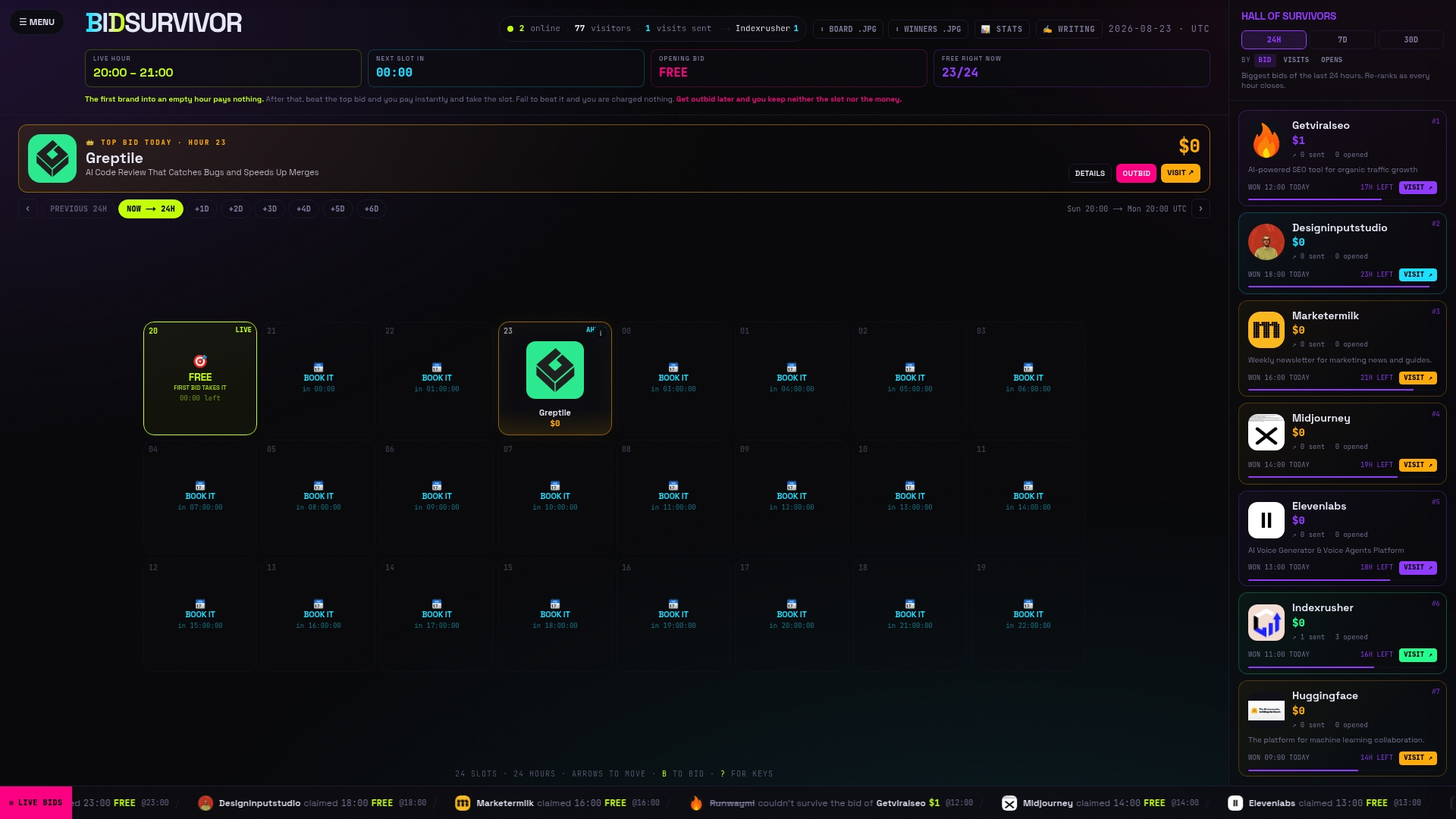
Getting started takes three moves: visit the BidSurvivor landing page, claim a free empty hour or place a small bid on a live one, and watch the public click stats update in real time. If you want to see what a live slot actually looks like before committing, check out an example campaign page to see how the logo, tagline, and link render together. New slots open constantly, and you can book up to a week ahead if you'd rather plan around a launch date than scramble same-day.
FAQ
How Many Clicks Do I Need Before I Trust the Data?
There's no fixed number, but treat anything under a handful of clicks as noise. Repeat your top-performing hour at least once before shifting budget based on it.
What Should My First Bid Be?
Start with a free claim if the hour is empty. If it's held, bid the smallest amount that beats the current holder rather than overpaying to guarantee a win.
Can I See Click Numbers Before I Bid?
Yes. BidSurvivor publishes every brand's click-through numbers publicly, so you can review performance history before placing a single bid.
How Fast Will I Know if the Test Worked?
You'll have click and CTR data within the hour the slot runs. Conversion data usually takes longer since it depends on your landing page's own funnel speed.
Should I Test the Same Hour Twice Before Deciding?
Yes. A single hour is one data point. Running your best hour a second time confirms whether the result was a pattern or a fluke.
Recommended
- Every ad platform shows you the winners
- What $200 actually buys you on Google Ads
- Why the first brand into an empty hour pays nothing
- The advertising that lasts forever is the advertising nobody sees
This article was produced with AI assistance and reviewed by AI for accuracy. It is provided for general information only and is not professional advice.