
A homepage takeover buys you exclusive front-page real estate on a publisher's site for a set window, usually with guaranteed share of voice against every other advertiser. Use it for a product launch, a flash sale, or an event you need everyone to see on a specific day. It costs more than standard display, often 2x to 10x the going CPM, and it demands more creative and technical prep than a banner buy. If your timing is loose or your creative isn't ready, skip it and save the premium.
TL;DR:
- Homepage takeovers are high-cost, premium ad placements that require precise creative assets and testing across device breakpoints to avoid layout breakage.
- Most publishers sell them as flat-fee daily sponsorships, which guarantee full share of voice but lack impression flexibility, while hourly and programmatic models suit smaller budgets or testing.
- Creative must be simple, with one clear message, short videos, and restrained animation, and should include fallback static images to prevent missed impressions.
- Technical setup issues, especially slow-loading ad slots or untested responsive designs, are the main cause of campaign underperformance, making pre-launch testing essential.
- Continuous monitoring during live campaigns and aligning cross-channel messaging across devices help maintain consistency and respond quickly to technical or creative issues.
Table of Contents
- What creative specs do homepage takeover ads require?
- Which buying model fits your budget: CPD, hourly, or programmatic?
- What technical mistakes cause homepage takeovers to fail?
- What creative concepts work best for homepage takeovers?
- What metrics should you request from the publisher?
- How do you troubleshoot a homepage takeover mid-campaign?
- How do you keep a takeover consistent across channels and devices?
- What legal and brand safety issues should you check before buying?
- How should you plan and target a homepage takeover campaign?
- When should you schedule a homepage takeover for maximum impact?
- A publisher's take on why hourly auctions beat the CPD negotiation
- Try an hourly front-page test with Bidsurvivor
- Where to check exact specs before you buy
- Sources
What creative specs do homepage takeover ads require?
Publishers publish detailed ad specs for a reason: a takeover that breaks the layout gets pulled, and you lose the day you paid for. Get the assets right before you sign anything.
Video creative typically runs 6 to 30 seconds, delivered as MP4 or MOV, at a minimum of 720p resolution. Most publishers cap file size somewhere between 2MB and 30MB depending on format, so check the exact ceiling before your creative team renders a final cut. Static skins and billboards vary by publisher, but expect leaderboard dimensions in the 970x250 range and full-page skins that wrap the background around a fixed center well. Image formats are almost always JPG or PNG, with byte limits enforced strictly at upload.
Text and brand assets carry their own rules. Spotify's ad-spec page requires advertiser name, tagline, and call-to-action copy within tight character counts, plus a logo delivered at a minimum pixel dimension so it doesn't pixelate on a 4K monitor. That level of precision is standard across premium publishers, not a Spotify quirk.
Desktop and mobile are two different builds, not one asset scaled down:
- Desktop skins wrap the full page background and need safe zones around the center content well.
- Mobile takeovers usually drop the skin entirely and fall back to a full-width banner or interstitial.
- Always deliver a fallback static image in case the video tag fails to load on a slower connection.
Pro Tip: Build your fallback static image first, then build the video. Teams that design video first often end up with a fallback that looks like an afterthought, which is exactly the asset most likely to run when a network hiccups.
Which buying model fits your budget: CPD, hourly, or programmatic?
Most publishers sell homepage takeovers as flat-fee, Cost-Per-Day sponsorships rather than impression-based buys. That's a deliberate choice on the publisher's side: CPD guarantees you full share of voice for the day, and it guarantees the publisher gets paid regardless of how the day's traffic shakes out. If you need certainty that nobody else's ad appears on that homepage, CPD is the model to ask for.
Hourly-auction marketplaces work differently and fit a different job. Instead of negotiating a flat day rate, you bid for a specific hour, see what it costs in real time, and walk away with published visitor and click numbers instead of a promise. This model suits smaller budgets, time-specific announcements, and anyone who wants to test the format before committing to a full-day buy.
Programmatic takeovers exist too, but they're less widely available than direct CPD deals. They trade full exclusivity for targeting and scale, and only work if your DSP and the publisher's ad server both support the integration.
Pricing moves on a few levers:
- Homepage traffic volume and the publisher's overall reach
- Time of day and day of week
- Full exclusivity versus partial share of voice
- Creative complexity, since a full-page skin with video costs more to trafficking teams than a static banner
What technical mistakes cause homepage takeovers to fail?
The single biggest failure mode isn't creative. It's the ad server setup underneath it. Rotational roadblocks, where every slot on the page has to load simultaneously to count as a complete takeover, frequently under-deliver because a single slow-loading unit breaks the whole thing. That's why publisher insiders steer critical campaigns toward CPD instead: a fixed sponsorship doesn't fall apart because one ad slot lagged for ten minutes.
Before you sign off on creative, run through this:
- Confirm the publisher has tested your skin at every responsive breakpoint, not just desktop and mobile as two static screenshots.
- Verify third-party tag support with the publisher's ad server before the launch date, not the morning of.
- Require all creative assets served over HTTPS, since mixed content gets blocked silently on many browsers.
- Get makegoods and rebate terms in writing before you pay, along with hourly delivery logs for short-window buys.
Pro Tip: Ask for a private preview link 48 hours before launch and load it on an actual phone, not a browser resize. Emulators miss the rendering bugs that real mobile Safari catches every time.
What creative concepts work best for homepage takeovers?
Design for one message, not five. A homepage takeover gets one shot at a visitor's attention before they scroll past, so the winning formula is a short headline, a bold logo, and a single call to action. Anything more and you've built a billboard nobody can read at highway speed.
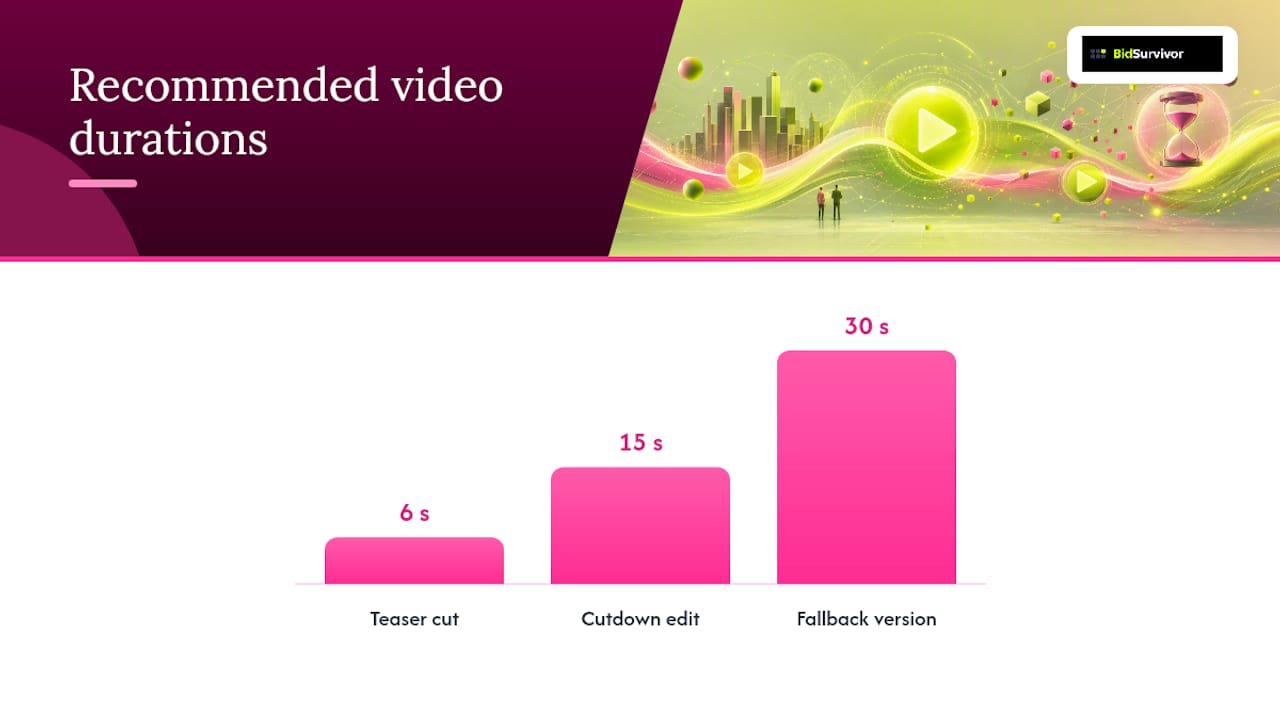
Video works best short. A 6 second teaser paired with a 15 second cutdown covers most placements, and you'll still want a 30 second version as a fallback for slots that support longer autoplay. Build every video edit to work silently, since most homepage placements autoplay muted by default.
A few concepts that consistently earn attention without wrecking the page experience:
- A product launch hero shot with a single headline and one link to the landing page
- A limited-time sale banner with a visible countdown timer
- An event registration push with a date, a location, and a direct signup link
| Format | Best for | Key requirement |
|---|---|---|
| Full-page skin | Brand launches | Responsive breakpoints tested |
| Billboard/leaderboard | Sales and promos | Short headline, single CTA |
| Video pushdown | Event announcements | Silent autoplay, 6s/15s cuts |
Keep animation restrained and always give the visitor an obvious way to dismiss or scroll past the unit. A takeover that traps navigation gets flagged by the publisher's own quality team before it ever reaches your audience.
What metrics should you request from the publisher?
Ask for homepage reach, viewability against IAB standards, click-through rate, and raw click logs, not just a summary PDF at the end of the campaign. Reach tells you how many unique visitors saw the page during your window. Viewability tells you whether the ad unit was actually in view long enough to count, which matters more on a full-page skin than people assume.
Reporting cadence should match the buy length. A single-hour or single-day placement should come with hourly delivery numbers so you can catch a technical failure while there's still time to fix it. A multi-day sponsorship warrants a daily summary at minimum.
Benchmark CTR against your own historical display numbers rather than an industry-wide average, since homepage inventory behaves differently site to site. If you want a real read on lift, run a brand-awareness survey before and after the takeover window, or compare direct traffic and branded search volume in the days surrounding the buy. That comparison tells you more than click data alone ever will.
How do you troubleshoot a homepage takeover mid-campaign?
Most problems surface in the first hour, which is exactly why you should be watching the dashboard live rather than checking back at end of day. If click-through rate looks flat within the opening thirty minutes, the first thing to check is whether the creative actually rendered correctly on the devices your audience is using. A layout that looks fine on your laptop can render broken on a mid-range Android phone with a slower GPU.

If visitor numbers look low relative to the publisher's stated homepage traffic, ask whether a rotational element is silently failing to load for a portion of visitors. That's the most common cause of an under-delivering takeover, and it's usually invisible unless someone is actively cross-checking impressions against the publisher's own traffic logs.
Watch for creative fatigue too, especially on multi-day buys. A skin that performed well on day one can see a steep click drop by day three simply because the same visitors have already seen it. If you've booked a longer sponsorship, build a second creative variant in advance so you can swap it in in without renegotiating the buy.
Finally, keep a direct line open with the publisher's ad ops team for the full duration of the campaign, not just at kickoff. The publishers who respond fastest to a mid-campaign flag are the ones who protect your spend when something breaks, and the ones who go quiet after the invoice clears are the ones you should think twice about rebooking.
How do you keep a takeover consistent across channels and devices?
A homepage takeover works hardest when it's not working alone. Pair it with paid social, email, and search around the same launch window so a visitor who misses the homepage still sees the same message somewhere else that day. The takeover buys you a burst of exclusive attention; the surrounding channels extend the reach past whoever happened to land on the homepage during your window.
Cross-device consistency is where a lot of campaigns quietly fall apart. The desktop skin and the mobile fallback need to carry the same headline, the same offer, and the same visual identity, even though the layouts differ completely. A visitor who sees a bold countdown timer on desktop and a generic banner on mobile will assume they're looking at two different promotions, not one campaign.
Build a single creative brief that specifies the message hierarchy once, then let your design team adapt it per format rather than building desktop and mobile as separate creative decisions. That keeps the headline and offer locked while the layout flexes to the device.
Link every version of the creative to the same landing page experience too. If your homepage skin promotes a specific sale price and the linked page shows a different offer, you've spent premium ad dollars driving traffic straight into a trust problem.
What legal and brand safety issues should you check before buying?
Confirm the publisher's brand safety policy covers adjacent content on the same page during your takeover window, especially on news sites where the surrounding editorial content changes hour to hour. A launch ad sitting next to a breaking news story about your own industry can read as either perfectly timed or deeply awkward, and you have no control over which once the buy is live.
Check who owns the creative rights to any co-branded assets, particularly if the publisher's sponsorship package includes a reskin of their own site elements. Some publisher packages bundle additional run-of-site impressions alongside the takeover itself, and the contract should spell out exactly what's included so there's no dispute after the invoice.
Review disclosure requirements too. Sponsored placements on editorial sites often carry "sponsored" or "advertisement" labeling requirements set by the publisher's own policy or by regulatory guidance in the publisher's market, and that labeling is not something you can negotiate away even on a premium buy.
Get the makegood and rebate language in writing before you pay, not after a technical failure. A verbal promise that "we'll make it right" means nothing once the invoice is closed and the ad ops contact has moved to a different account.
How should you plan and target a homepage takeover campaign?
Start with the calendar, not the creative. Identify the exact date and hour your announcement needs maximum visibility, then work backward to confirm the publisher has that inventory available. Premium homepage slots on major sites book out weeks in advance, and the highest-traffic hours go first.
Match the publisher to your actual audience rather than chasing the biggest traffic number on the rate card. A tech-industry publisher with a smaller but tightly relevant readership will often outperform a general news site with ten times the visitors, simply because the people viewing it are already primed to care about what you're launching.
If your audience is global, ask about the publisher's time zone handling for the takeover window. A takeover that runs on Eastern Time delivers most of its impact to a very different slice of your audience than one timed to Central European business hours.
Set your goals before you buy. A takeover aimed at brand awareness should be judged on reach and viewability. A takeover aimed at direct response should be judged on click-through rate and post-click conversion. Buying the format without deciding which goal it's serving is how teams end up disappointed with a placement that actually performed fine against a different objective than the one they quietly expected.
When should you schedule a homepage takeover for maximum impact?
Timing decides more of your outcome than creative quality does. A takeover that runs during your audience's actual browsing hours beats a better-designed one that runs while they're asleep, every time.
For single-day CPD buys, weekday mornings through early afternoon tend to capture the highest volume of engaged, work-context browsing on B2B and news publishers. Consumer sites often see stronger weekend traffic, so match the day of week to where your audience actually lives.
For hourly or multi-hour buys, treat the format as a series of small tests rather than one long buy. Booking a single hour lets you measure performance against a specific moment, an event start time, a product drop, a livestream, without committing to a full day's premium. If that hour performs well, extend into a multi-hour sponsorship around it rather than guessing at the right window up front.
Book earlier than feels necessary. Premium inventory on well-trafficked publishers often sells out a week or more ahead, and the best available slots disappear fastest around major shopping periods and industry events.
A publisher's take on why hourly auctions beat the CPD negotiation
I run an hourly advertising board, so I'll say plainly: most of what makes CPD sponsorships painful isn't the format, it's the negotiation. You spend two weeks going back and forth on rate, exclusivity terms, and makegood language before a single impression runs.
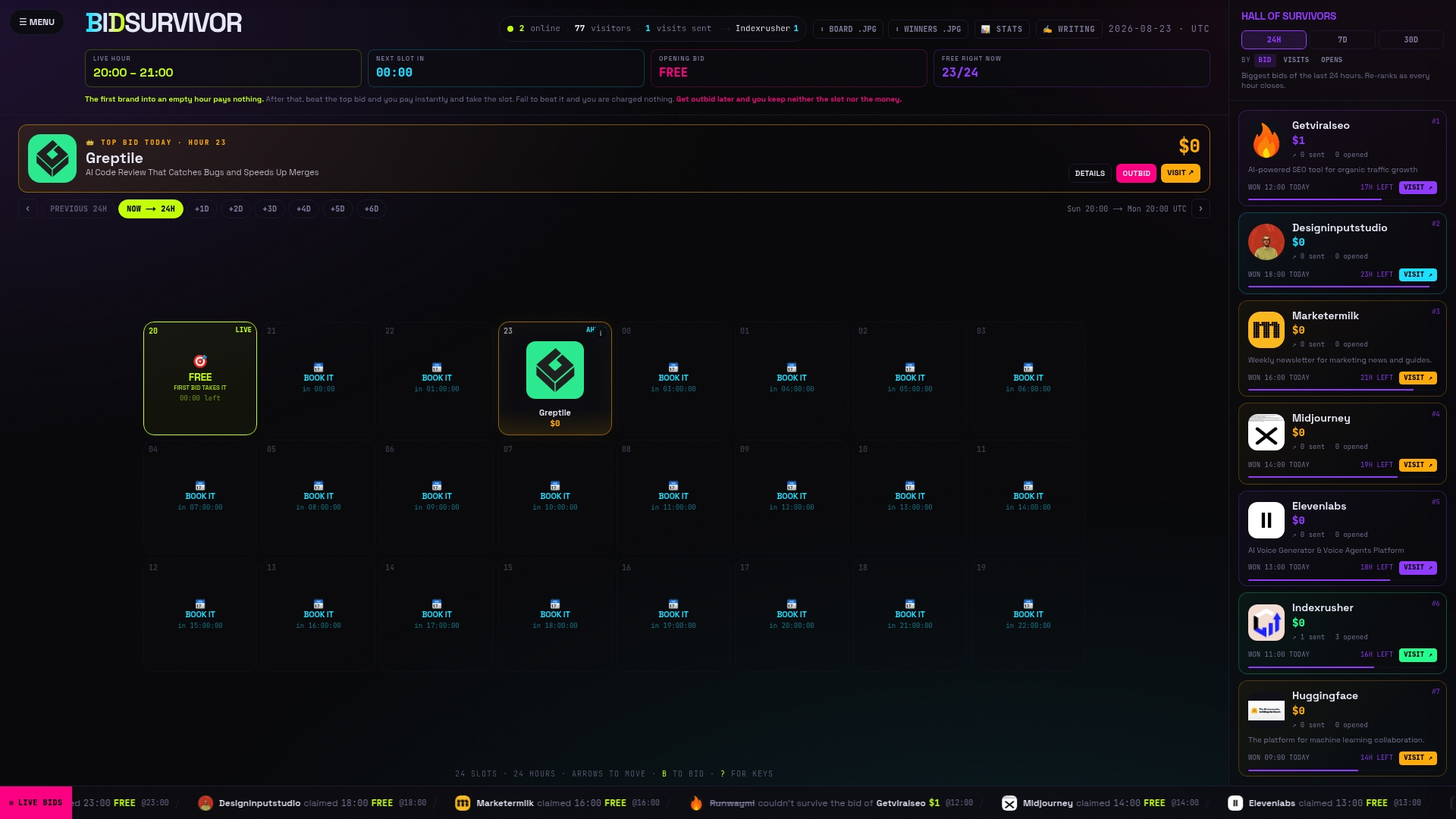
Bidsurvivor's board is 24 tiles, one per hour of the UTC day. Winning a tile gets you the front of the page for that hour: logo, name, one line, direct link. There's no negotiation because the price is whatever the standing bid says, and the visitor and click numbers are published per brand, so you're not waiting on a publisher's summary PDF to know what you got.
That model isn't a replacement for a full-day CPD buy on a major launch. It's the right tool for a low-budget test, a time-specific push, or simply proving to yourself that homepage-style exposure converts before you commit real money to a longer sponsorship.
— nrupak
Try an hourly front-page test with Bidsurvivor
Bidsurvivor is the low-friction alternative to a two-week CPD negotiation: no subscription, no minimum spend, and every hour's visitor and click count published for anyone to check. You bid on an empty hour and pay nothing if nobody outbids you later. You bid on a taken hour, beat the standing bid from a $1 floor, and the slot is yours the moment you win.
A smart way to test the format costs you less than one premium CPM. Book a single off-peak hour, watch the clicks and visitor count come in live, then compare that cost against what a comparable CPM buy would have run you on a standard display network. If the numbers work, extend into a multi-hour run or grab a spot on the Hall of Survivors with a bigger bid. Book your hour on Bidsurvivor's board and see what a single hour of front-page exposure actually delivers.
Where to check exact specs before you buy
Pull the publisher's own ad-spec page before finalizing creative, since dimensions and file limits vary site to site and change without much notice.
- Search Engine Land's homepage takeover guide for pricing benchmarks and delivery risks
- Spotify's ad-spec page for exact character and pixel requirements
- BizJournals' takeover flex specs for how sponsorship bundles get structured
- Southern California's sponsorship page for example sponsorship packages and commercial terms
Sources
- Homepage takeover — Search Engine Land ad size guide
- Homepage takeover specs & requirements | Spotify Ads