

If you need results in hours, not weeks, prioritize three moves: boost your best-performing social post to a warm audience, blast email and SMS to your recent purchasers and cart abandoners, and check remnant inventory for placements sold at 50 to 80 percent off standard rates. Before you spend a dollar, confirm your landing page is live, your tracking links work, and you have held back 5 to 10 percent of budget for whatever opportunity shows up at hour eleven.
- Boost social posts to lookalike or retargeting audiences, not cold traffic
- Segment email/SMS by purchase intent and send within the hour
- Call two or three remnant sellers; discounts widen sharply 24 to 72 hours before air
Pro Tip: Discounts on unsold airtime and outdoor space often deepen the closer you get to the deadline, so a media buyer who waits until the last 24 hours sometimes pays less than one who books a week out.
Key Takeaways
Last minute advertising works best when preapproved creative, segmented audiences, and remnant inventory discounts of 50 to 80 percent combine with fast, hourly-level measurement.
| Point | Details |
|---|---|
| Prioritize warm channels first | Boost social to retargeting audiences and send segmented email/SMS before chasing cold traffic. |
| Buy remnant inventory strategically | Discounts widen to 50 to 80 percent in the 72 to 24 hour window before air. |
| Keep a budget reserve | Hold back 5 to 10 percent of spend so you can act the moment a deal appears. |
| Track hourly, pivot fast | Use promo codes and UTMs to measure conversions daily or hourly, then reallocate underperforming spend. |
| Use Bidsurvivor for instant placement | Bid on an open hour with no subscription required and published click/visitor stats to gauge results immediately. |
Table of Contents
- Fast-Launch Channel Tactics for Last Minute Advertising
- What Is Remnant Inventory and How Do You Buy It Fast?
- Building a Creative and Operations Checklist Before You Need It
- How Do You Measure a Campaign You Only Have a Day to Run?
- Why an Hourly Auction Board Fits Last-Minute Advertising Needs
- What Are the Risks of Moving Fast on Advertising?
- Best Practices for Audience Segmentation Under Time Pressure
- How to Adapt Creative and Messaging in Hours, Not Weeks
- Legal and Compliance Considerations for Fast-Turnaround Ads
- Rules of Thumb for Choosing Tactics Under Pressure
- Claim Your Hour: A Three-Step Path to Same-Day Visibility
- Sources
Fast-Launch Channel Tactics for Last Minute Advertising
Speed only works if you know which lever to pull first. Here's the order that tends to produce results fastest, channel by channel.
- Paid social. Boost an existing post with proven engagement rather than launching a new campaign from zero. A boosted post inherits its social proof and usually clears platform review faster than a fresh campaign. Keep creative specs simple: a 15-second vertical video, a static 1080x1080 image, and one urgency-driven headline under seven words. Target warm audiences first: retargeting pools, email list uploads, and lookalikes built from recent buyers.
- Search. Raise bids on your highest-converting keywords for the remaining window and add dayparting so spend concentrates around your event or deadline. Swap ad copy to urgency language ("Today Only," "Last Chance," "Ends Tonight") since generic evergreen copy underperforms in short bursts.
- Email and SMS. Segment into three lists: recent purchasers (upsell), cart abandoners (recovery), and high-intent subscribers who opened your last three sends. A two-line SMS with a promo code and direct link converts faster than a long-form email when the clock is running.
- Creators. Skip the multi-week brief. Reach out to micro-influencers with a simple ask: one story post or one short clip, posted within 24 hours, in exchange for a flat fee or affiliate code. Platforms like Black X simplify managing these fast, low-friction creator deliverables.
- Local and offline. Flyer high-traffic spots near your venue, activate a local Facebook group post, or pay for a same-day boosted listing on a local events calendar. These channels are slow to scale but fast to launch, which is exactly what a short window needs.
For events specifically, countdown posts, repeated reminders, and simplified "one-click" ticket links consistently drive last-minute conversions, according to event marketing guidance built around exactly this kind of compressed timeline. Fast paid search and retargeting setups from resources like event campaign guides can also shortcut the technical setup when you have hours, not days.
What Is Remnant Inventory and How Do You Buy It Fast?
Remnant inventory is unsold ad space, broadcast airtime, or outdoor placement that a seller would rather discount than let go dark. Every media owner overbooks slightly and every campaign falls through, which leaves gaps that need filling before the slot expires and earns nothing.
The discounts scale with urgency. Guides on last-minute media buying report remnant inventory commonly sells at 50 to 80 percent off standard rate cards, with some sellers going as high as 90 percent when timing is ideal. The steepest discounts tend to appear in a narrow window: roughly one week out, then again in the final few days before air (https://www.radioadvertisinghome.com/how-to-negotiate-last-minute-airtime-rates/), when the seller's incentive to fill the slot outweighs holding out for full price.
Negotiating that discount comes down to a few consistent moves:
- Ask for bonus spots or added value rather than just a lower rate
- Accept preemptible placements, which can be bumped for a full-price buyer but cost far less
- Shop two or three sellers simultaneously since remnant pricing varies by relationship
- Keep a standing budget reserve so you can commit the moment a good rate appears
Lead times differ by channel. Broadcast and radio can close in hours if you already have approved creative; out-of-home and programmatic digital often move even faster, sometimes within the same day.
Building a Creative and Operations Checklist Before You Need It
Last-minute advertising rewards preparation more than improvisation. The brands that win remnant deals and fast approvals are the ones who already have assets sitting ready, not the ones scrambling to build them after the opportunity appears.
- Pre-build creative variants. Keep a 15 second and 30 second video cut, a square and vertical static image, and three headline variants on hand at all times. Practitioner guides on remnant buying consistently point to ready creative as the single biggest factor separating advertisers who can act fast from those who miss the window entirely.
- Standardize tracking. Set a UTM naming convention you reuse every time, generate a unique promo code per channel, add a QR code to any physical or outdoor placement, and use call tracking numbers if phone leads matter to your campaign.
- Shortcut your approvals. Pre-clear a small set of message templates and creative formats with legal and brand teams so a same-day launch doesn't need a fresh sign-off chain. Limit QA to the checks that actually matter: does the link work, does the promo code apply, is the phone number correct.
- Reserve your budget. Set aside 5 to 10 percent of total media spend specifically for opportunistic buys. This is the money that lets you say yes in the ten minutes a remnant seller gives you to decide.
Pro Tip: Build one landing page template with swappable headline and offer fields instead of designing a new page for every campaign. You'll cut launch time from hours to minutes.
How Do You Measure a Campaign You Only Have a Day to Run?
Short campaigns need short feedback loops. Track sales, promo code redemptions, click-through rate, conversion rate, and cost per acquisition on an hourly basis during the final day of an event push, then shift to daily checks in the days before.
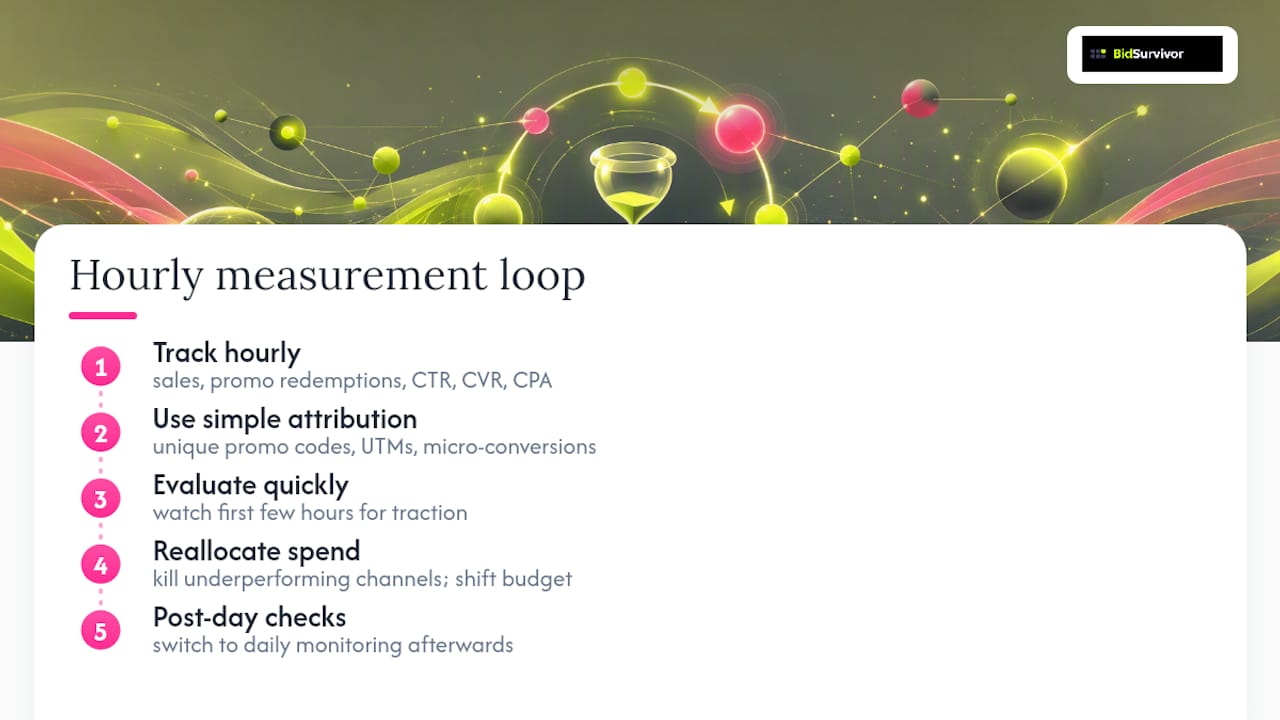
Attribution gets simple by necessity: a unique promo code per channel, campaign-specific UTMs on every link, and a landing page micro-conversion (email capture, ticket click) tell you almost everything you need without a complex model. If a channel isn't converting within the first few hours, kill the spend and reallocate it to whichever channel is already showing traction rather than waiting for it to improve. This kind of rapid reallocation only works if your tracking is already built before launch, which is why the operational checklist above matters as much as the creative itself.
Why an Hourly Auction Board Fits Last-Minute Advertising Needs
An hourly auction removes the two things that usually slow down a last-minute buy: negotiation time and pricing uncertainty. Bidsurvivor runs a 24-tile board, one tile per hour of the UTC day, where the current owner's logo, name, tagline, and link occupy the front of the page. An empty hour costs nothing to claim. An occupied hour requires beating the standing bid, from a $1 floor, charged the instant you win. Lose the hour later to a higher bidder and the slot changes hands, no invoice, no back-and-forth.
- Hours are bookable up to a week ahead, which fits both planned pushes and same-day scrambles
- No subscription or minimum spend means a single hour is a complete, standalone buy
- Visitor and click counts are published per brand, so you're not buying blind
- Winning bids can also earn placement on the Hall of Survivors for 24 hours, 7 days, or 30 days
The whole point of remnant-style buying is removing the friction between "I need visibility right now" and "I have visibility right now." An auction board with public performance numbers and a one-click bid does that without a single phone call to a sales rep.
Pair a winning hour with a simultaneous social boost or email send and you get concentrated exposure at the exact moment your audience is most likely to be paying attention.
What Are the Risks of Moving Fast on Advertising?
Speed cuts both ways. The same compression that lets you launch in an hour also strips out the safety checks a longer timeline would normally catch.
Remnant inventory is unpredictable by nature. You're buying leftover space, which means the exact placement, time slot, or ad position isn't always guaranteed the way a planned buy would be. Preemptible spots, in particular, can be bumped by a full-price advertiser after you've already paid, so treat those as a bonus channel, not your primary one.
Rushed creative underperforms more often than not. A headline written in ten minutes rarely tests as well as one refined over a week, and typos or broken links slip through when QA gets compressed to "does it look okay." Skipping proper QA to save an hour can cost you the entire campaign if the promo code doesn't work or the landing page 404s.
Budget discipline slips under pressure too. It's easy to chase a discount that looks too good to pass up and blow through your reserve on one channel, leaving nothing for the next opportunity that shows up two hours later. And short-term thinking, taken too far, can dilute brand consistency: rushed messaging sometimes drifts from your usual voice in ways that confuse repeat customers even as it wins new ones.
None of this means last-minute advertising is a bad bet. It means you treat speed as a constraint to manage, not a free pass to skip the fundamentals.
Best Practices for Audience Segmentation Under Time Pressure
You don't have time to build a new audience from scratch, so the fastest path is refining audiences you already own. Recent purchasers, cart abandoners, and high engagers each need a different message, and sending the same generic blast to all three wastes the one advantage speed gives you: relevance.

Recent purchasers respond best to upsell or referral offers since they've already proven intent. Cart abandoners need a direct nudge, often with a small incentive, because they were close to converting and something stopped them. High-intent subscribers who've opened your last several emails are your warmest cold audience: they know your brand but haven't acted, so urgency plus a clear offer usually moves them.
On paid social, skip broad targeting entirely. Build a retargeting pool from site visitors in the last 30 days, layer a lookalike audience from your customer list on top, and geo-fence around your event location if physical proximity matters. This narrow approach costs less per click and converts at a higher rate than broad targeting, which matters even more when your budget is compressed into a single day.
If you're promoting an event, segment by proximity too. Someone within driving distance needs a "get your ticket now" message; someone further away might respond better to a livestream or on-demand option instead. Sending the wrong offer to the wrong distance segment wastes the exact urgency you're trying to create.
How to Adapt Creative and Messaging in Hours, Not Weeks
Rapid creative adaptation isn't about writing from scratch. It's about having a flexible template and knowing which two or three variables actually move performance.
Start with your best-performing existing asset, not a blank page. If a past social post or email drove strong engagement, swap its offer and headline rather than rebuilding the whole creative. This preserves whatever made it work while updating it for the new context.
Urgency language does real work in short windows. Phrases like "today only," "last chance," and "ends tonight" consistently outperform generic evergreen copy in last-minute campaigns, according to event marketing practitioners who track this pattern closely. For outdoor and display formats, keep headlines to roughly seven words with large typography and one clear call to action, since a passerby or scroller has half a second to register your message.
Test only what you can act on immediately. With a day or two of runtime, you don't have room for a full A/B test matrix, so pick one variable, usually the headline or the offer, and run two versions side by side. Whichever pulls ahead within the first few hours gets the remaining budget.
Keep a bank of pre-approved copy variants for exactly this moment. Three headline options, two calls to action, and one urgency phrase you can drop into any format cuts your creative turnaround from hours to minutes.
Legal and Compliance Considerations for Fast-Turnaround Ads
Compressed timelines don't compress your legal obligations, and this is where rushed campaigns tend to create real liability rather than just weaker performance.
Claims made under urgency still need to be accurate. "Today only" needs to actually mean today only. Advertising a discount, availability, or limited quantity that isn't true can trigger regulatory scrutiny in markets with truth-in-advertising rules, regardless of how fast the campaign was built. If your promo code has a real expiration, honor it publicly and don't quietly extend it without updating the messaging.
Platform-specific ad policies still apply even when you're boosting an existing post rather than launching new. Social platforms review boosted content for prohibited claims, and a rushed approval process on your end doesn't protect you from the platform's own rejection or, worse, a policy violation after the ad has already spent budget.
SMS and email compliance rules don't relax for last-minute sends. Recipients still need to have opted in, and unsubscribe mechanisms still need to work, particularly relevant when you're pulling lists together quickly under pressure and might be tempted to include contacts whose consent has lapsed.
If your campaign touches a regulated category, alcohol, health claims, financial offers, sweepstakes rules, build in time for a compliance check even if it's brief. A five-minute review by someone who knows the relevant restrictions is far cheaper than a pulled campaign or a fine after the fact.
Rules of Thumb for Choosing Tactics Under Pressure
Match the tool to the goal. Chasing ticket sales in the next 24 hours means paid social and SMS; building awareness for something further out means remnant broadcast or OOH instead.
If your budget is thin, spend it on the channel you can measure fastest, usually promo-coded email or SMS.
Short-term tactics done well also build brand strength rather than working against it, so don't treat speed and brand consistency as opposites. Whatever you run this time, track it properly. The campaign you're improvising today becomes the playbook you execute calmly next time.
— nrupak
Claim Your Hour: A Three-Step Path to Same-Day Visibility
Everything above assumes you can move the moment an opportunity opens, and that's exactly what Bidsurvivor is built for. There's no proposal, no media kit exchange, no waiting on a sales call. You look at the board, you act, and the placement is live.
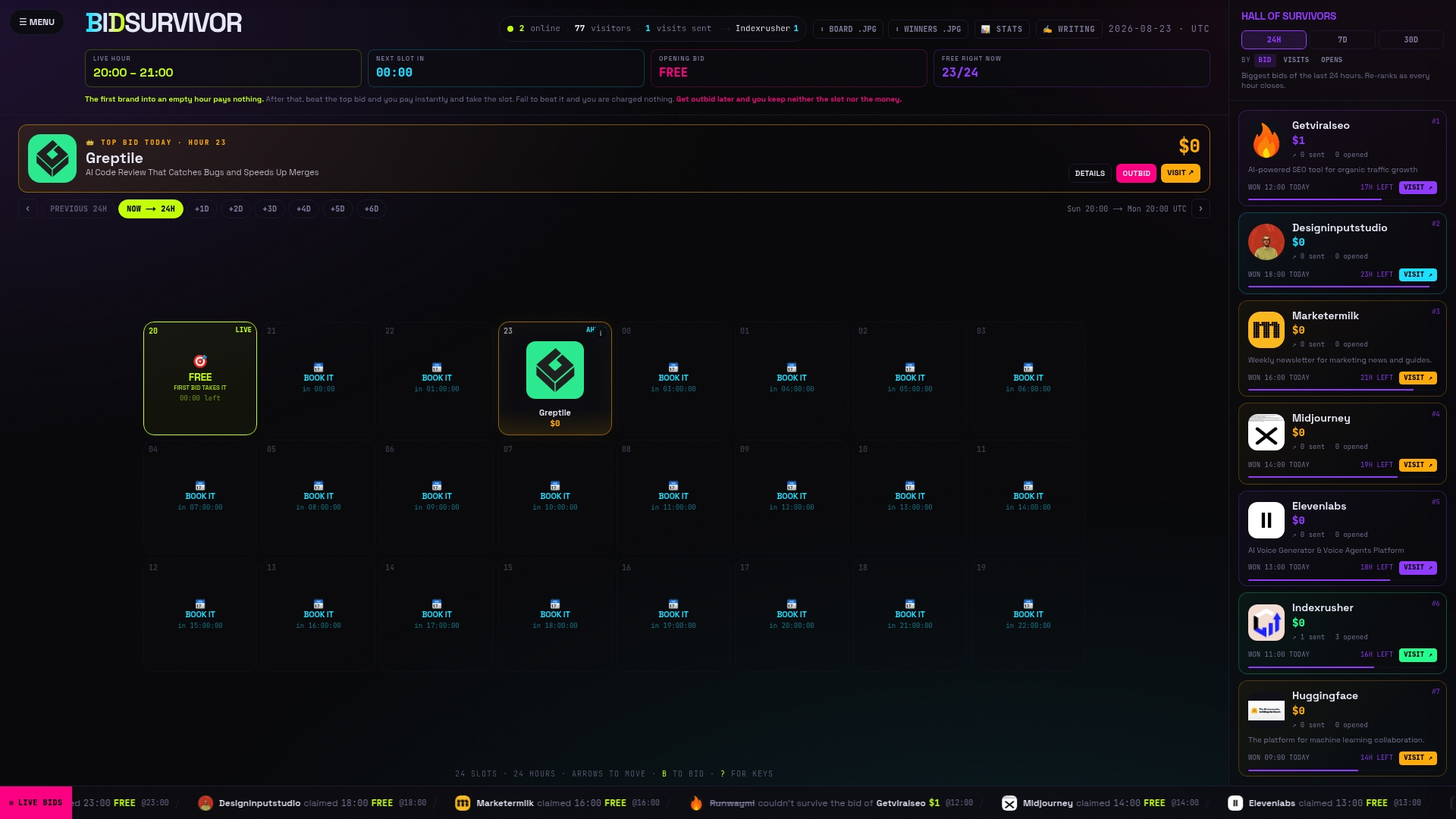
Getting a slot takes three steps. First, check the 24 hour board for an open hour, which costs nothing to claim outright. Second, if the hour you want is already taken, submit a bid that beats the standing amount, starting from a $1 floor, and you're charged only the moment you win. Third, once you're live, watch your published visitor and click counts update in real time so you know within the hour whether the placement is earning its keep.
There's no subscription and no minimum spend sitting behind any of it, which matters most when you're deciding in the last few hours before an event or deadline whether a placement is worth the money. Pair a winning hour with the social or email push you just built and you get a concentrated burst of exposure exactly when your audience is paying attention. Check the current board and place your bid to see which hours are open right now.
Sources
- Last-Minute Media Buying Strategies for 70% Lower Ad Costs
- How to Negotiate Last Minute Airtime Rates
- Short-term growth, long-term gains: can you really have both?
- LAST-MINUTE MARKETING TIPS FOR YOUR EVENTS