
A one-line pitch for an hourly ad tile has one job: stop a scroll and hand over a single, sharp reason to click, in roughly five to eight words. It has to survive next to a logo and a link with nothing else to lean on. Bidsurvivor publishes visitor and click numbers per brand, so you can measure whether that promise actually converts before you rebid.
TL;DR:
- Using clear, specific, and measurable claims like numbers or defined outcomes in short lines significantly improves click-through rates compared to vague or clever phrasing.
- Tailor the line to your target audience's device, time zone, and intent, and ensure it matches your landing page's promise to avoid bait-and-switch perceptions.
- Test multiple line variants within a single hour using tools like Bidsurvivor to identify the most effective pitch based on actual visitor response data.
- Keep the line tightly focused on one objective, such as offers, social proof, or curiosity, and avoid mixing multiple messages to prevent confusion.
- Ensure your line aligns with your brand voice and truthfulness, as the small ad space offers no room for disclaimers or misrepresentation.
Table of Contents
- One Line Pitch Examples Organized by Objective
- How Do You Write a One-Line Pitch That Works?
- Fill-In-The-Blank Formulas for Fast Testing
- What a Real Tile Tagline Tells You About Performance
- Brand Fit and Tile Constraints
- One-Line Pitches vs. Taglines vs. Elevator Pitches
- Tailoring the Line to Who's Actually Looking
- What the Data Actually Says About Short Pitches
- Test Every Line Before You Trust It
- Sources
One Line Pitch Examples Organized by Objective
The best one-line pitch examples aren't clever for cleverness's sake. Each one is built to do a specific job: sell a discount, plant a brand impression, spark curiosity, borrow credibility, or push a click. Pick the objective first, then pick the line.
Promotional offers. These work when the deal itself is the hook. Keep the number visible.
- "Save on hosting this hour only"
- "First 50 signups get lifetime pricing"
- "Free shipping ends when this hour does"
Brand-building. No discount, no urgency, just a clean statement of what you do and for whom. These pair best with a homepage rather than a landing page, since there's no offer to fulfill.
- "The CRM built for solo founders"
- "Design software that never asks for a login"
- "Insurance that actually answers the phone"
Curiosity hooks. These borrow from the short-form hook framework Google Business recommends: open with something unresolved and let the click finish the thought.
- "Most SaaS pricing pages lie. Ours doesn't."
- "We killed our own best feature. Here's why."
- "The tool your accountant doesn't want you to find"
Social proof and metrics. A real number does more work than an adjective ever will. If your platform publishes stats, use them, the way a published click count acts as its own credibility signal.
- "12,000 marketers switched last month"
- "Rated 4.9 by 3,000 verified buyers"
- "Built by the team behind [Category Leader]"
Direct CTAs. Blunt, verb-first, and best matched to a landing page that delivers exactly what the line promises. No detours.
- "Start your free trial in 10 seconds"
- "Book your demo before the hour ends"
- "Claim your spot. 3 left."
Match each line to a landing page that pays off the specific promise. A curiosity line that dumps a visitor on a generic homepage wastes the click you just earned. A short product tagline like the ones AI tool builders use can be adapted for tech audiences the same way, swapping in the specific automation benefit instead of a generic feature claim.
How Do You Write a One-Line Pitch That Works?
Length and clarity aren't style choices here, they're constraints imposed by the tile itself. Get the mechanics right before you get clever.
- Cap it at 5 to 10 words. Ad headlines typically perform best in this range, and product taglines often run even tighter, at 3 to 8 words. On a small tile, every extra word competes with your logo for space.
- Pick one hook format and commit. A question ("Still paying for hosting you don't use?"), a contrast ("Slower agencies charge more for less"), a number ("500 brands tested this in 30 days"), or a command ("Claim your hour before it's gone"). Mixing two formats in one line usually just muddies both.
- Say one thing. The most common failure in short copy is trying to pitch a discount and a feature and a brand statement in the same eight words. Pick the single strongest claim and cut the rest.
- Avoid generic CTAs. "Click here" and "learn more" tell a reader nothing. Specific urgency beats generic urgency every time, so "Sale ends in 3 hours" outperforms "Limited time offer" because it's a claim someone can verify.
- Don't oversell. If the line promises something the landing page can't deliver in the first five seconds, you'll get the click and lose the sale in the same breath.
Pro Tip: Write the landing page headline first, then reverse-engineer your tile line from it. If the two don't share a word or a number, a visitor will feel bait-switched the moment they land.
Before you lock a line, run it against your brand voice and your landing page's actual promise. If either doesn't match, the click is wasted no matter how sharp the hook is.
Fill-In-The-Blank Formulas for Fast Testing
You don't need to write from scratch every time. Five structures cover most of what works on a tile, and these formula patterns hold up across strict character limits:
- Benefit + number: "Cut [cost] by [X]% starting today"
- Problem → quick result: "Tired of [pain]? Fixed in [timeframe]."
- Social proof shortform: "[Number] [audience] already switched"
- Time-limited offer: "[Discount] ends in [timeframe]"
- Curiosity cliff: "The [category] trick nobody talks about"
A line like "Fixed 500 founders' invoicing in a day" pulls from three of those buckets at once.
Test one variable at a time. Swap only the number or only the verb between two versions of the same hour, then compare click-through rate rather than gut feeling. Watching visitors-per-hour alongside clicks tells you whether the line is pulling attention or just pulling clicks that bounce.
What a Real Tile Tagline Tells You About Performance
A tile that ran the line "Save on your next audit" during a booked hour recorded its visitor and click counts publicly on the board, the same way every hour's numbers get published. Run the same offer with a different hook the next week and you have a real comparison, not a guess.
| Metric | What it tells you |
|---|---|
| Visitors | Raw exposure for that hour |
| Clicks | How many acted on the line |
| Click-through rate | Whether the line, not just the traffic, is working |
| Hall of Survivors placement | Whether the win was strong enough to earn extended visibility |
A high enough bid earns a spot on the Hall of Survivors for 24 hours, 7 days, or 30 days, which gives a winning line a second life beyond its original hour. That's worth factoring into which line you commit real bid money to.
Brand Fit and Tile Constraints
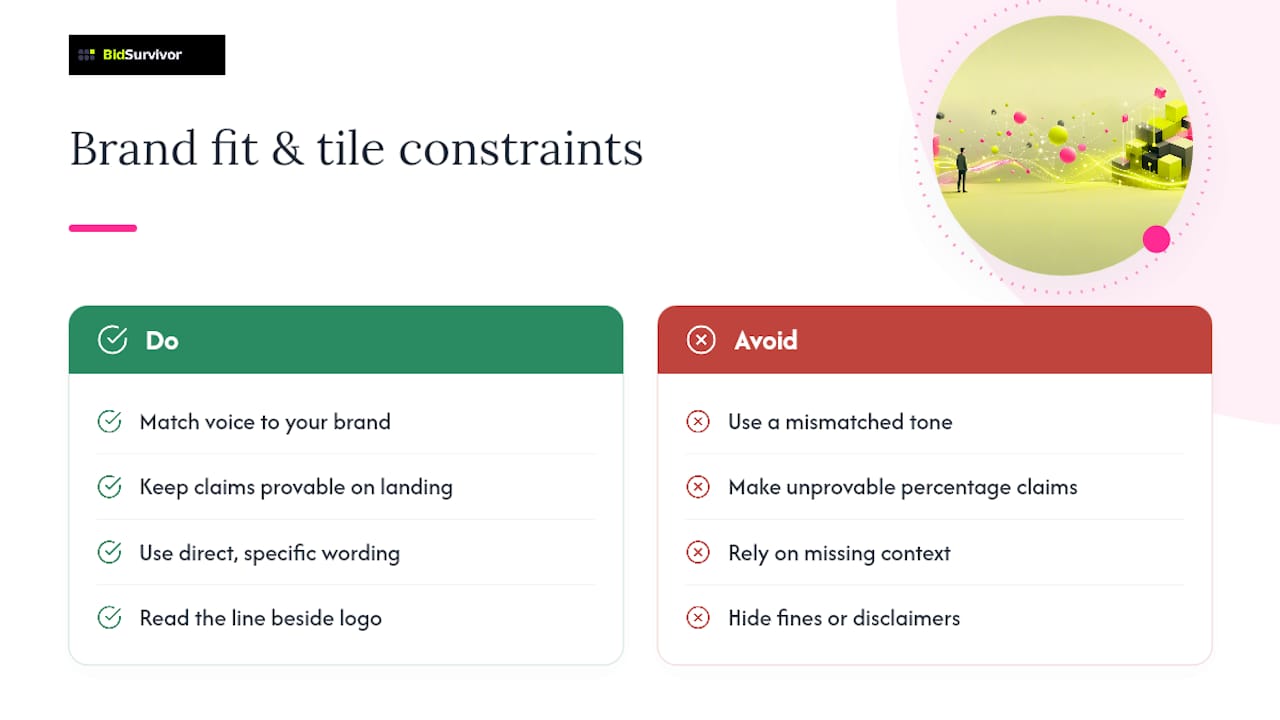
A tile only gives you a logo, a name, one line, and a link, so brand fit has to happen inside that single sentence. There's no subhead to soften a tone mismatch and no image to carry personality the way a display banner can.
Match voice before you match message. A playful, lowercase brand shouldn't suddenly run a formal, corporate-sounding line just because it tests well elsewhere; a visitor who clicks expecting one tone and lands on another loses trust before they even read the page. If your usual voice is direct and specific, per the keyword and differentiator guidance Google Ads gives advertisers, keep that same directness in the tile line rather than defaulting to something punchier just because the space is small.
Compliance matters just as much as tone. The line has to be true the second someone clicks; an hourly board doesn't give you room for a disclaimer or fine print, so a claim like "cut costs 40%" needs to hold up on the landing page that follows. Character limits force the same discipline that Google Ads headline rules demand: say the real thing, in the real words, with nothing left to interpretation.
Test your line by reading it next to your logo, nothing else. If it needs context your brand hasn't already built with visitors, it's the wrong line for a format this compressed.
One-Line Pitches vs. Taglines vs. Elevator Pitches
These three get used interchangeably, and that's a mistake that leads to the wrong kind of line on the wrong kind of tile.
A tagline is permanent brand language, built to outlast any single campaign. It doesn't sell, it identifies. A one-line pitch, the kind this article is about, is tactical and disposable, built for one hour, one offer, one test. It can borrow language from your tagline, but its job is to convert a specific click in a specific window, not to represent the brand forever.
An elevator pitch is a spoken, multi-sentence explanation, usually 30 to 60 seconds long, meant for a conversation, not a tile. It has room to build context, explain a problem, and land a close. A one-line pitch has none of that room. Trying to compress an elevator pitch into eight words usually produces something vague enough to mean nothing, which is the opposite of what a tile line needs.
The practical distinction: your tagline should survive a rebrand review five years from now. Your one-line pitch should survive exactly one hour of traffic, then get replaced, tested, or rebid based on what the numbers actually said.
Tailoring the Line to Who's Actually Looking
The visitor scrolling past an hourly board at 3 AM UTC isn't the same visitor scrolling at 2 PM. Time zone, likely intent, and even device size shift by the hour, and your line should account for that instead of running one static message on repeat.
For B2B audiences buying on logic, lead with a number or a specific outcome rather than a mood. For consumer audiences buying on impulse, urgency and curiosity tend to outperform pure benefit statements, since the decision cycle is shorter and there's less appetite for evaluating a claim.
Device matters more than most marketers account for. A line that reads cleanly on desktop can wrap awkwardly on mobile, where the tile crops differently. Front-load the strongest word so the promise lands even if the tail end gets cut off visually. If you're bidding across multiple hours to reach different regions, write a second variant for whichever hour draws a different audience mix rather than assuming one line travels equally well across all 24.
What the Data Actually Says About Short Pitches
Most advice on short copy treats every line the same, as if a curiosity hook and a discount offer should be judged by identical standards. They shouldn't. A curiosity line succeeds by earning a click on intrigue alone, and its landing page has to resolve that intrigue fast or the bounce rate erases whatever the tile line accomplished. A discount line succeeds by being specific and true, and it fails the moment the number on the tile doesn't match the number on checkout.
The conventional wisdom oversells "clever." Plenty of marketers chase a line that sounds smart in a meeting and dies on a real tile because it tried to say too much. The lines that hold up under actual traffic are almost boringly direct: a number, a benefit, a timeframe. Save the wit for the brand-building slot, where there's no offer to undercut.
What should you prioritize first? Not the line itself, the landing page it points to. Write that first, then pull your tile line from its strongest, most specific sentence. A great line pointed at a mismatched page is worse than an average line pointed at a page that delivers exactly what it promised.
— nrupak
Test Every Line Before You Trust It
Bidsurvivor turns your one-line pitch into an actual measurable test instead of a guess sitting on a static ad.
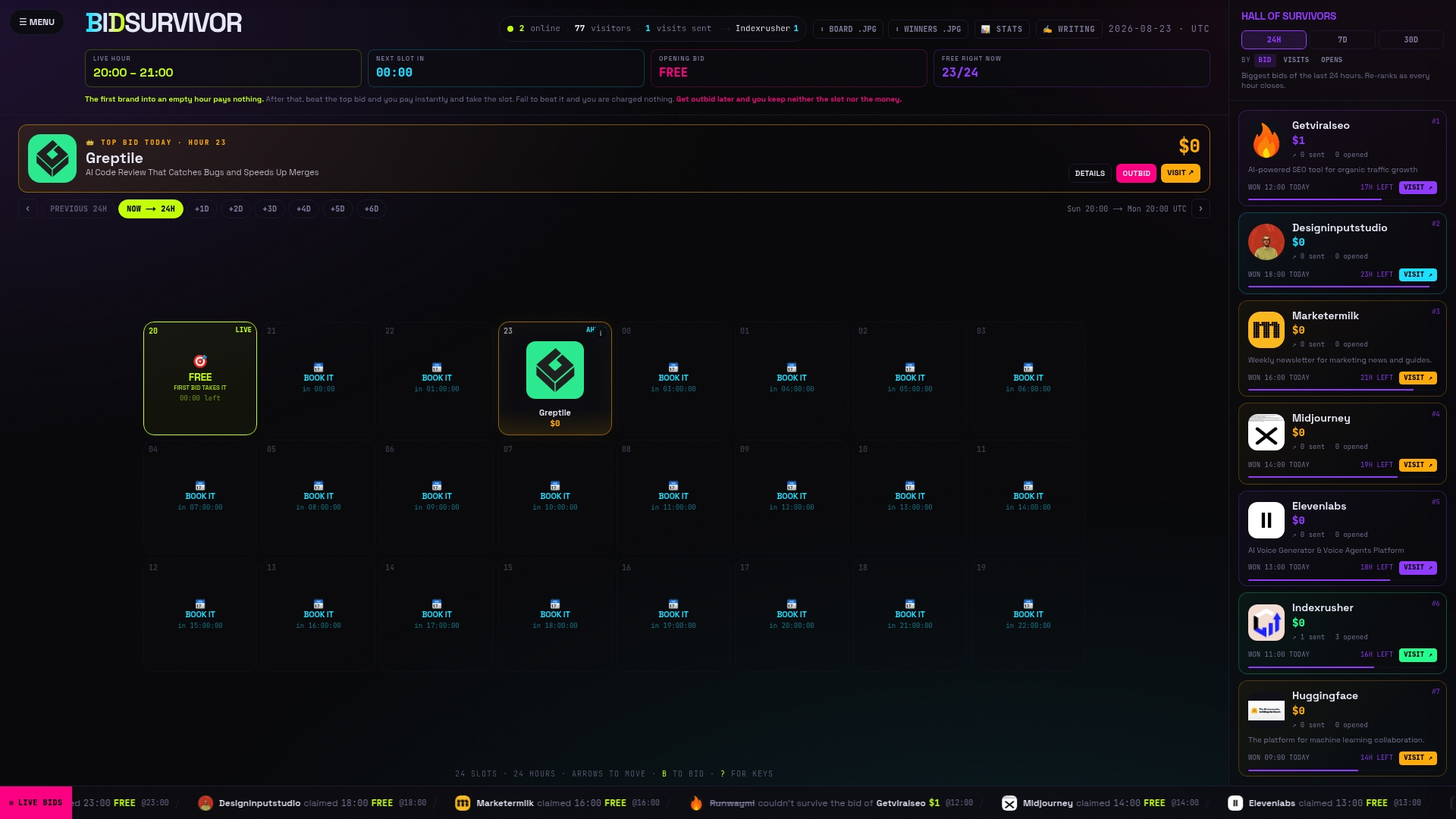
There's no subscription and no minimum spend, so you can claim an open hour for free or bid to take over an occupied one starting at a $1 floor, only paying if your bid wins. That means you can run five different taglines across five separate hours in a single week for less than most platforms charge for a single day of impressions, then keep the line that actually earned clicks. A strong enough bid also lands you on the Hall of Survivors for extended visibility beyond your hour.
Check the current board and claim your hour to run your first tagline test today.
Sources
- How to Write Short Copy That Actually Converts | Edwriting
- Create responsive search ads assets - Google Ads Help
- How to Write Google Ad Headlines That Convert (With Character Limits Cheat Sheet) | TextKit Blog
- Short-form video advertising tips | Google Business Think with Google