

Pay-as-you-go advertising means you fund a specific ad event, an hour, an impression batch, a set of clicks and pay only when that event happens, nothing before, nothing after. It's a good fit if you're running small tests, a seasonal promotion, or a limited-time offer and don't want a monthly bill following you home. Programmatic and AVOD buying have made this kind of targeted, event-based purchase far more common than it was five years ago, according to Statista's outlook on AVOD advertising. My advice: start small, treat your first campaign as a small-budget experiment, and don't sign anything longer than a week.
- Test before you commit. A single hour or a few hundred impressions tells you more than a slide deck ever will.
- BidSurvivor's 24-tile hourly auction board is one working example: no subscription, bids start at a $1 floor, and you only pay when you win.
- If the numbers hold up after one test, scale the spend. If they don't, you've lost a coffee budget, not a quarter's marketing plan.
Key Takeaways
Pay-as-you-go advertising works because it ties every dollar spent to a confirmed event, letting small businesses test ideas at $100 to $500 instead of the $10,000 minimums common in managed programmatic buys.
| Point | Details |
|---|---|
| Match model to goal | Use CPM for awareness, CPC for traffic, validated views or per-slot pricing for sales-focused tests. |
| Test small first | Run a $100 to $300 test over 48 to 72 hours before committing a larger budget. |
| Set triggers before launch | Decide your pause and scale thresholds (CTR, CPC, conversion rate) ahead of time, not mid-campaign. |
| Demand validated reporting | Ask vendors for per-event click and view data plus a clear invalid-traffic refund policy. |
| Consider hourly auctions | BidSurvivor's 24-tile board lets you win a specific hour for a one-time bid starting at $1, with public per-brand click and visitor stats. |
Table of Contents
- How Does Pay-As-You-Go Advertising Actually Work?
- What Does Pay-As-You-Go Advertising Cost?
- Who Actually Benefits From Pay-As-You-Go Advertising?
- How to Run Your First Pay-As-You-Go Test
- How Do You Measure Results Without Overspending?
- A Real Example: How BidSurvivor's Hourly Auction Works
- Why the Retainer Model Doesn't Deserve Its Reputation for Safety
- Try BidSurvivor for Your Next Pay-As-You-Go Test
- Sources
How Does Pay-As-You-Go Advertising Actually Work?
Every pay-as-you-go model runs on a billing trigger, the event that actually charges your card. The four you'll run into most often:
- CPM (cost per thousand impressions): you pay when your ad is shown, regardless of clicks.
- CPC (cost per click): you pay only when someone clicks through.
- Validated views: you pay for confirmed, non-bot views, common in video and influencer marketplaces.
- Hourly or slot wins: you pay once, upfront, to own a specific placement for a fixed window of time.
The workflow is nearly identical across all four: pick your inventory (a display slot, a video pre-roll, an hour on an auction board), set a bid or budget cap, launch, and get billed the moment qualifying events happen. That's the whole mechanism. There's no invoice at the end of the month because the invoice already happened, event by event.
Where it gets interesting is the split between auctioned and campaign-funded models. An auctioned hourly slot, like the ones on BidSurvivor's board, gives you time-bound ownership: you win the hour, you own the front of the page for that hour, full stop. A campaign-funded marketplace instead spreads your budget across however many impressions or clicks it can serve before the money runs out. One gives you a guaranteed placement; the other gives you a guaranteed spend cap with a variable outcome.
Pro Tip: Ask for per-event reporting before you launch, not after. If a platform can't show you click counts or visitor numbers in real time, you're flying blind on your own money.
What Does Pay-As-You-Go Advertising Cost?
Costs vary by billing model, and knowing the difference between them keeps you from comparing apples to hourly bids.
- CPM typically runs from a few dollars to $20+ per thousand impressions depending on format and audience specificity.
- CPC ranges widely by platform and competition, often landing between $0.50 and $3 for search or display, higher for competitive niches.
- Validated views on influencer or creator marketplaces are billed only after a view is confirmed, which protects you from bot inflation but usually carries a platform fee on top.
- Hourly slot wins are a flat one-time charge, no per-click math required, you know your total cost before you click "bid."
Here's where minimums matter. Amazon Ads recommends a minimum campaign budget for self-serve online video campaigns and a higher minimum budget for managed-service packages, numbers that put most small business budgets out of reach entirely. That's the exact gap pay-as-you-go platforms exist to fill: no minimum, no retainer, spend $100 if that's what you have.
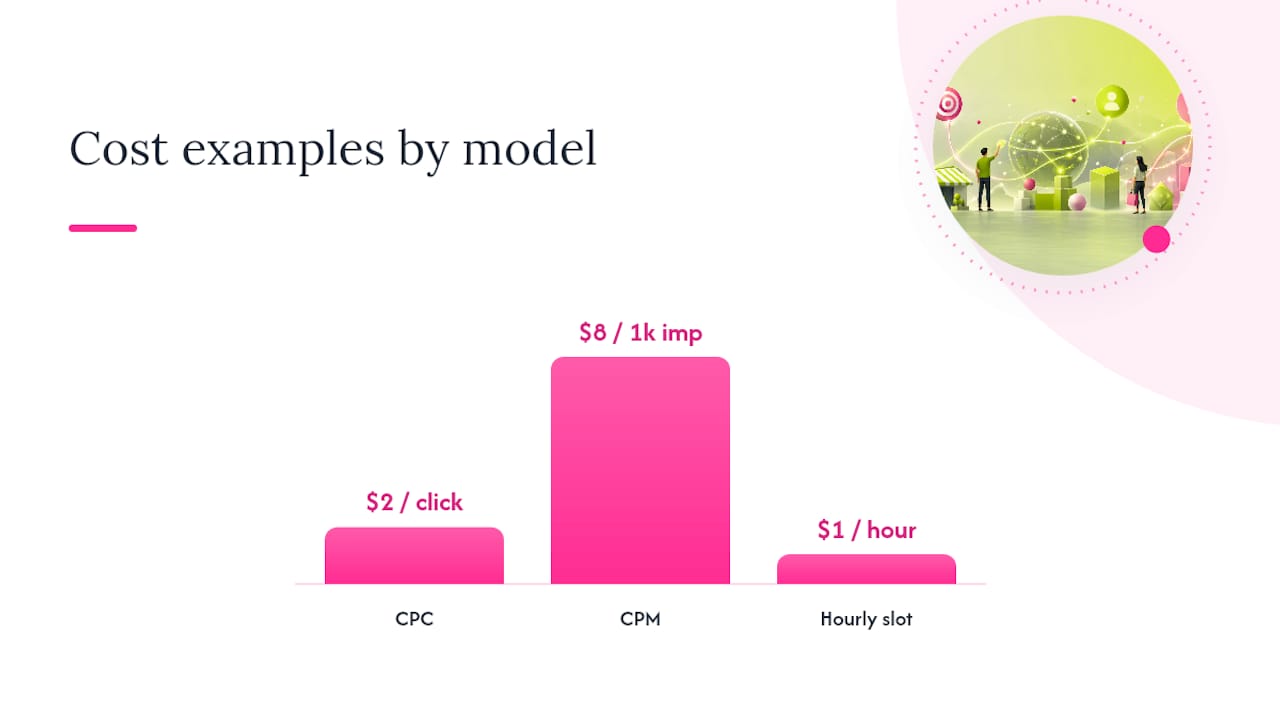
Take a $100 to $500 test budget. At $2 CPC, $500 buys roughly 250 clicks. At an $8 CPM, it buys about 62,500 impressions. On an hourly auction board with a $1 floor, that same $500 could win you several hours outright, or one highly contested peak hour if competitors are bidding it up. The trade-off is precision versus volume: CPC gets you fewer, more qualified visitors; CPM gets you reach; hourly slots get you guaranteed visibility for a fixed price.
Before you commit, ask any vendor: What counts as a validated event? Is there a platform fee on top of my bid? What happens if traffic looks fraudulent, do I get a refund or a credit?
Who Actually Benefits From Pay-As-You-Go Advertising?
This model isn't universal. It shines in specific situations and struggles in others.
Good fit:
- Seasonal sellers who need a burst of visibility around a specific week (holiday sale, back-to-school, a product drop).
- Event-driven promos with a hard start and end date.
- A/B creative testing, where you want to compare two headlines without funding a month-long campaign for each.
- Small local businesses testing a new offer before scaling spend.
Better served by a longer buy:
- Brand campaigns that need sustained frequency over weeks to build recall.
- Businesses chasing awareness metrics that only move with repeated, cumulative exposure.
Match your goal to your model: awareness campaigns lean toward CPM, lead generation leans toward CPC, and direct sales promos often do best with validated-view or per-slot pricing where you're paying for a confirmed outcome, not just a shot at one.
How to Run Your First Pay-As-You-Go Test
Here's a four-step template you can copy without needing a media buyer on staff.
Step 1: Set one objective and one billing model. Pick a single KPI, clicks, leads, or sales, and choose the billing model that matches it. Don't run a CPM test if your actual goal is conversions; you'll be measuring the wrong thing.
Step 2: Prepare one creative with one CTA. Resist the urge to test five headlines at once. Running low-budget bursts with two or three creative variations against a single audience slice keeps your results clean enough to actually learn from.
Step 3: Set a budget and a time window. For a first test, $100 to $300 over 48 to 72 hours is enough to generate signal without burning your whole quarter's ad money. If you're bidding on hourly slots, look at how time-limited placements perform before setting your bid, peak hours cost more for a reason.
Step 4: Monitor and set pause triggers in advance. Decide your thresholds before you launch, not while you're staring at a dashboard.
Pro Tip: Write your pause and scale triggers down before launch. Watching a live campaign and deciding "in the moment" is how budgets get burned on hope instead of data.
How Do You Measure Results Without Overspending?
Match your metric to your objective. Awareness campaigns live and die by impressions and CPM. Traffic campaigns care about CTR and CPC. Sales campaigns need CPA (cost per acquisition) or ROAS (return on ad spend), full stop, nothing else matters as much.
Short campaigns make attribution tricky. Use UTM parameters on every link, keep your measurement window tight (24 to 72 hours matches your test window), and treat email signups or add-to-carts as conversion proxies when a full sale takes longer to close.
- Ask for validated click and view reporting before you buy, not after you're disputing a bill.
- A sudden CTR or traffic spike with no matching lift in conversions is the classic invalid-traffic red flag.
- Platforms that publish per-brand click and visitor counts make fraud verification far easier than platforms that hand you a single aggregate number.
- If a vendor can't explain a spike, ask directly what their refund or credit policy covers.
A Real Example: How BidSurvivor's Hourly Auction Works
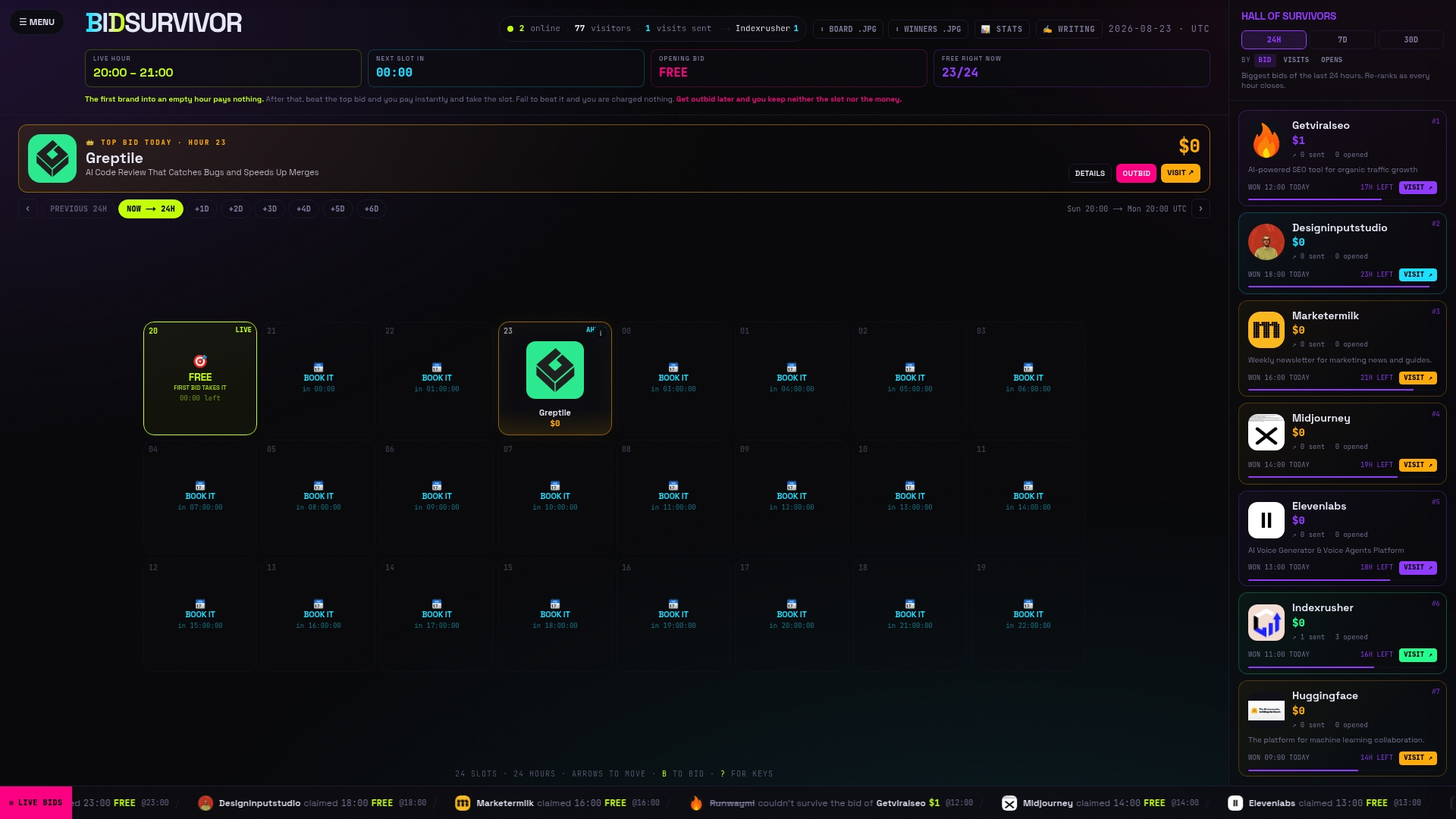
BidSurvivor runs a 24-tile board, one tile for every hour of the UTC day. Whoever holds a tile owns the front of the page for that hour: logo, name, one line of copy, and a direct link to their own site. It's about as transparent a pay-as-you-go model as exists.
- The first brand into an empty hour pays nothing to claim it.
- Taking an occupied hour means beating the standing bid, starting from a $1 floor, and you're charged the instant you win.
- Get outbid later, and the slot and your money are both gone, no refund, no argument, that's the mechanic.
- Winning bids also earn a spot on the Hall of Survivors for 24 hours, 7 days, or 30 days depending on bid size.
- Every visitor and click number is published per brand, so you can check whether an hour is actually performing before you bid on it again.
The whole point of publishing visitor and click numbers per brand is that you shouldn't have to take anyone's word for it, including ours. Look at what a live slot actually looks like before you bid, not after.
Hours are bookable up to a week ahead, and there's no subscription or minimum spend required to try it once.
Why the Retainer Model Doesn't Deserve Its Reputation for Safety
Most small business owners assume a retainer or a long-term ad contract is the "safe" choice, and a pay-as-you-go test is the risky one. I'd argue that's backward. A retainer locks in your spend before you know if the creative works, the audience is right, or the platform's traffic is even clean. Pay-as-you-go flips the risk: you find out fast, cheap, and you can walk away without penalty if the numbers don't hold up.
What gets underrated is reporting transparency. Plenty of platforms will happily take your retainer and hand you a monthly PDF with aggregate numbers you can't verify. A model where every click and visitor count is published per advertiser, the way BidSurvivor structures its board, gives you something a retainer rarely does: the ability to check the math yourself, in real time, before you bid again.
My honest read: the reader who wins here isn't the one who finds the cheapest CPM. It's the one who tests first, reads the actual per-event data, and only scales spend once a small bet has already proven itself.
— nrupak
Try BidSurvivor for Your Next Pay-As-You-Go Test
Bidsurvivor skips the retainer entirely: instead of committing to a monthly ad budget before you know what works, you bid on a single hour, pay only if you win, and see your click and visitor numbers published the moment the hour starts. That's the core difference from a managed campaign or a subscription-based ad tool, no minimum spend, no recurring charge, no waiting on a media buyer to report back.
If you're testing a seasonal promo or a new offer, book an empty hour for free or bid on a contested one starting at $1. Check an active slot on the board to see exactly what a winning hour looks like, then claim your own hour up to a week ahead and watch your numbers update in real time.