

Real-time ad bidding is a per-impression programmatic auction where a supply-side platform, an ad exchange, and multiple demand-side platforms decide who owns a single ad slot before the page finishes loading. The whole transaction, from bid request to render, typically clears in well under 100 milliseconds. The dominant pricing model is CPM, cost per thousand impressions, and the dominant protocol is OpenRTB. Here's what a single auction involves:
- A supply-side platform (SSP) packages the impression and sends it to the exchange
- A demand-side platform (DSP) evaluates the request and returns a bid, often built with Prebid.js adapters on the publisher side
- The exchange picks a winner and clears the price, then the creative renders
Statistic Callout: Academic measurement of live RTB traffic found consistent periodic patterns in bid volume, and confirmed that first-price outcomes dominate in practice despite second-price auction rules still being common in spec.
Key Takeaways
Real-time ad bidding auctions clear in milliseconds through a chain of SSP, exchange, and DSP decisions, and the pricing model you assume, first-price or second-price, determines whether your bidding strategy overpays or underperforms.
| Point | Details |
|---|---|
| RTB clears fast | Bid request to creative render typically completes in well under 100 milliseconds. |
| First-price is now common | Soft floors and header bidding pushed most exchanges toward first-price-like payment outcomes. |
| Header bidding raised floors | Prebid.js style setups increase publisher revenue but add latency and integration complexity. |
| Temporal modeling drives ROI | Bidders that ignore time-of-day and recency patterns consistently underperform those that model them. |
| Transparent platforms exist | Bidsurvivor publishes real visitor and click data per winning brand instead of aggregated estimates. |
Table of Contents
- How Does a Real-Time Bidding Auction Actually Work?
- What Are the Core Components of an RTB Ecosystem?
- Why Does the Auction Model Change What You Actually Pay?
- What Protocol Details Matter for RTB Implementation?
- How Did Header Bidding Change RTB Pricing?
- What Optimization Levers Actually Move RTB Performance?
- What Privacy Risks Should RTB Architectures Address?
- What Should a Practical RTB Audit Checklist Include?
- What Does Transparent RTB Data Actually Look Like?
- How Machine Learning Reshapes Bid Decisions
- How RTB Compares to Programmatic Direct
- What Conventional RTB Advice Gets Wrong
- Want to See Transparent Ad Auction Data Firsthand?
- Sources
How Does a Real-Time Bidding Auction Actually Work?
The sequence starts the moment a browser or app requests a page and a slot becomes available for sale.
- The publisher's ad server or SSP builds a bid request containing impression metadata: site or app ID, ad unit size, device type, geography, and whatever user signals it's permitted to pass (a hashed ID, contextual category, or first-party segment).
- The SSP forwards that request to one or more ad exchanges, which broadcast it to connected DSPs simultaneously. This is where header bidding, covered below, changes who gets a look and in what order.
- Each DSP's bidder logic scores the impression against active campaigns. It checks budget pacing, frequency caps, targeting rules, and a predicted value (usually a conversion or click probability) before deciding whether to bid and at what price.
- The DSP returns a bid response. The exchange picks the winning bid, calculates the clearing price, and fires the win notice.
- The publisher's ad server renders the winning creative, and pixels fire for viewability and attribution tracking.
Every one of those five steps happens inside the same round trip that would otherwise just be a blank ad slot loading.
What Are the Core Components of an RTB Ecosystem?
Four pieces of infrastructure do distinct jobs, and confusing them is where a lot of implementation mistakes start.
- Supply-side platform (SSP): manages yield for publishers, sets price floors, and maintains connections to multiple exchanges to maximize competition for each impression.
- Demand-side platform (DSP): houses the bidding logic, targeting rules, budget pacing, and reporting that advertisers use to buy inventory across many exchanges at once.
- Ad exchange: runs the actual auction, matches bid requests to bid responses, and enforces the clearing rules (first-price, second-price, or a hybrid).
- Ad server: sits on the publisher side, decides which demand source wins the slot when multiple sources compete, and handles the actual creative delivery.
- Data providers: feed identity and behavioral signals into the DSP's bidding model, entering the pipeline before the bid request is even constructed.
Why Does the Auction Model Change What You Actually Pay?
Second-price auctions were the original RTB standard: the winner pays one increment above the second-highest bid, not their own full bid. First-price auctions charge the winner exactly what they bid, full stop. Most exchanges shifted toward first-price mechanics over the last several years, largely because header bidding made it impractical to run a clean second-price auction across dozens of simultaneous demand sources.
Soft floors complicate this further. A publisher can set a reserve price that effectively forces the winning bid up toward the floor regardless of true second-highest demand, which pushes outcomes closer to what a first-price auction would produce anyway.
Measurement of live RTB traffic found that despite formal second-price rules, soft floors and reserve pricing made first-price-like payment outcomes the practical norm, not the exception.
Statistic Callout: That same research also documented clear periodic patterns in impression volume, bid density, and conversion rates tied to time-of-day and day-of-week cycles, a signal that shows up again in the optimization section below.
Bid shading, where a DSP intentionally bids below its true valuation, exists specifically to counteract first-price overpayment risk. The CPM your dashboard reports is the clearing price, not necessarily the algorithm's internal valuation, and the gap between those two numbers is exactly where shading strategies live.
What Protocol Details Matter for RTB Implementation?
OpenRTB governs the request/response structure nearly every exchange uses, and Google's Authorized Buyers documentation is the clearest public reference for how fields, latency requirements, and response construction actually work in production.
- Parse
imp(impression),device,geo, anduserobjects first. They carry the scoring signals most bidders weight heaviest. - Choose Protobuf over JSON if your bidder needs to shave microseconds off serialization; JSON is easier to debug but costs you parsing time at scale.
- Authorized Buyers uses protocol variants that diverge slightly from vanilla OpenRTB. Confirm which spec version an exchange runs before assuming field compatibility.
- Budget your latency in the tens of milliseconds, not the hundreds. Peering closer to exchange data centers and caching creative assets locally are the two most reliable fixes when timeouts spike.
Pro Tip: Log every timeout separately from every no-bid. A bidder that's silently losing to latency looks identical to one that's just not competitive, unless you're tracking response time as its own metric.
How Did Header Bidding Change RTB Pricing?
Header bidding lets publishers send the same impression to multiple exchanges simultaneously, in the page header, before the ad server's traditional waterfall even runs. Prebid.js became the standard way to manage this, coordinating bidder adapters that each connect to a different exchange or DSP and feeding all resulting bids into the ad server for a unified decision.
- Publishers generally see higher clearing prices because more demand competes for the same impression at once, rather than waiting in a sequential waterfall.
- Buyers face a flatter, more competitive landscape. The old trick of waiting for lower-tier waterfall steps to find cheap inventory works less often now.
- The trade-off is added latency, since every extra adapter call is another network round trip before the page can render.
- Header bidding also nudged reserve prices upward across the board, since publishers use the wider demand pool as leverage for higher floors.
What Optimization Levers Actually Move RTB Performance?
Most bidding strategies fail not because the model is wrong, but because it ignores time. Industry research consistently finds that bidders ignoring time-of-day and time-series signals underperform ones that model temporal patterns explicitly.
- Build a temporal model. Impression volume and conversion likelihood both swing by hour and day of week, so a static bid price wastes budget during low-value windows and underbids during high-value ones.
- Weight recency and frequency together, not separately. A user seen five minutes ago and a user seen five days ago should never get the same bid price, even inside the same audience segment.
- Automate budget pacing so spend doesn't front-load early in the day and starve later, higher-converting hours.
- In first-price environments, run bid shading with a feedback loop: track win rate against clearing price weekly and adjust the shade factor rather than setting it once and leaving it.
Pro Tip: Treat pacing and shading as connected, not separate systems. A pacing algorithm that smooths delivery but ignores clearing price trends will happily overpay during exactly the hours your shading model should be pulling back.
What Privacy Risks Should RTB Architectures Address?
Regulators have taken a direct interest in what data actually travels inside a bid request. The FTC's case against Mobilewalla centered on exactly this: location and behavioral data collected through RTB bidstream traffic and repurposed beyond its original ad-targeting context.
- Never pass raw PII in a bid request. Hash or tokenize identifiers before they leave your server.
- Run consent checks upstream of the bidder, not inside it, so a rejected consent state never reaches your logging pipeline.
- Favor server-side aggregation for reporting so individual-level signals don't need to persist longer than the auction itself.
Statistic Callout: Privacy-driven signal loss is a known trade-off. As identifiers get stripped or coarsened, bid models lose precision, which is exactly why contextual and first-party segment strategies have gained ground as a replacement input.
What Should a Practical RTB Audit Checklist Include?
A working audit covers four categories, and skipping any one of them is usually where post-launch fires start.
- Engineering: confirm OpenRTB parsing handles all required fields, latency stays inside your SLA, and every request/response pair is logged with a timestamp.
- Testing: run synthetic bid requests before going live, load-test for peak QPS, and A/B test any change to bidding logic against a held-out control group.
- Operations: monitor floor prices daily, set pacing rules per campaign, and QA every creative render manually before a campaign scales.
- Measurement: track win rate against bid price, compare clearing price to your own valuation model, and follow the funnel all the way to conversion, not just to click.
Pro Tip: *Win rate alone tells you almost nothing.
What Does Transparent RTB Data Actually Look Like?
Most programmatic reporting hides the numbers that matter behind aggregated dashboards. Bidsurvivor runs an hourly advertising auction where every winning brand's visitor and click counts are published, not estimated, not modeled.
- The board shows 24 tiles, one per UTC hour, each with its own bid history and traffic numbers visible to anyone.
- Bidsurvivor's blog breaks down real advertising economics in plain terms, including a piece on what $200 actually buys on Google Ads, the kind of granular spend breakdown most platforms never publish.
- That transparency mirrors what RTB auditors should demand internally: real clearing prices and real traffic, not modeled approximations.
How Machine Learning Reshapes Bid Decisions
Bidding logic used to run on static rules: fixed CPM caps, fixed targeting, fixed pacing curves. Machine learning models now predict conversion probability per impression and adjust bid price accordingly, which is a meaningfully different approach than the rule-based bidders that dominated RTB's first decade.
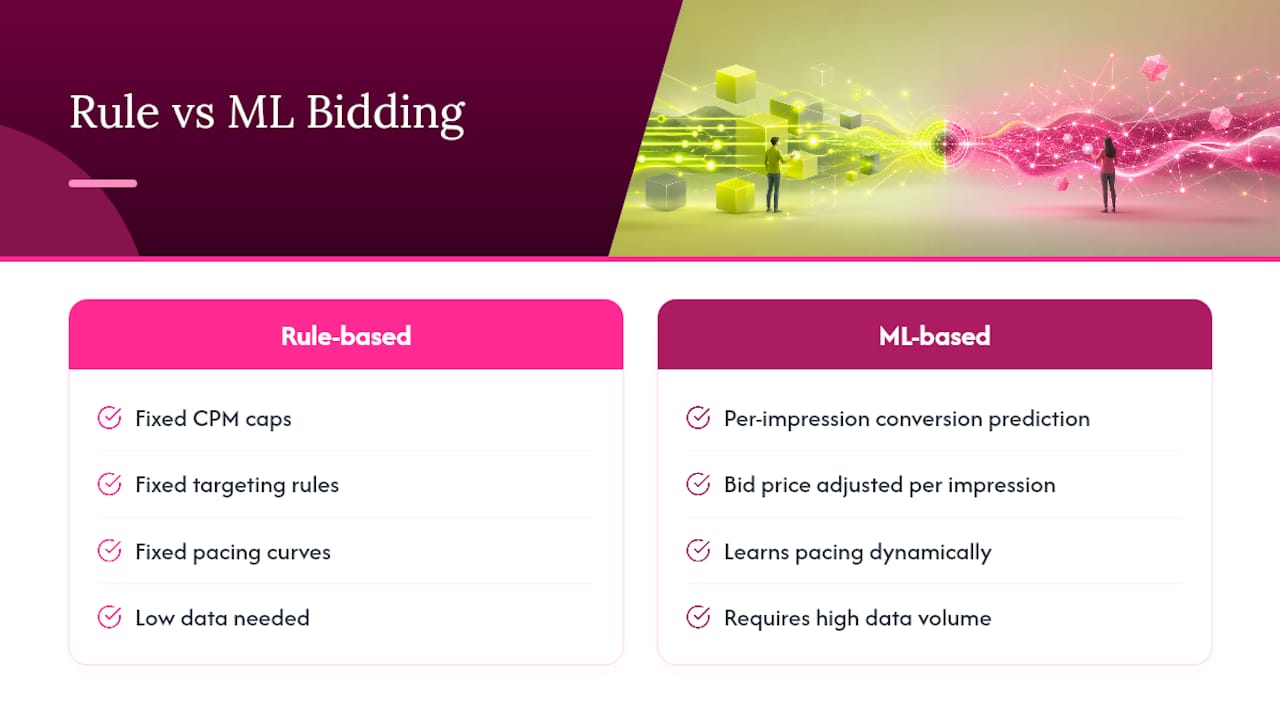
The catch is that these models need volume to work. A DSP running a small budget campaign often can't generate enough training data for its own model to outperform a well-tuned static rule, which is a detail that gets left out of most vendor pitches. Game-theory research on display auctions has also found that RTB raises aggregate publisher revenue but produces asymmetric outcomes for advertisers, where reservation contracts still outperform RTB for advertisers who can't compete on data volume. That's worth knowing before assuming machine learning bidding is automatically the better choice for every campaign size.
How RTB Compares to Programmatic Direct
Programmatic direct skips the auction entirely: a fixed price and fixed inventory get negotiated in advance, automated through the same pipes RTB uses but without the real-time competitive bid. RTB wins on flexibility and reach across unsold inventory; programmatic direct wins on predictability and guaranteed placement. Header bidding actually blurred this line further, since it changed the allocation order between reservation deals and RTB inventory, pushing publishers to hold reservation contracts to a higher price bar now that RTB competition sets a visible floor.
What Conventional RTB Advice Gets Wrong
Most explainers treat RTB like a solved problem: plug in a DSP, set a targeting rule, watch the dashboard. That framing skips the part that actually determines outcomes, which is that the auction mechanics themselves shift under you. Second-price auctions were the assumption an entire generation of bidding strategies got built on, and that assumption has quietly eroded as soft floors and header bidding pushed the market toward first-price behavior. A bidder still running valuation logic tuned for second-price economics is leaving money on the table every single auction cycle.

The bigger blind spot is transparency, or the lack of it. Most programmatic reporting is aggregated, modeled, and one step removed from the actual transaction. You see a CPM average, not the clearing price on any single impression. That's precisely why platforms that publish raw numbers, real visitor counts, real click totals, matter more than they get credit for. You can't optimize a bidding strategy you can't actually see clearly.
If there's one priority for readers building or auditing an RTB pipeline, it's this: instrument for clearing price and win rate together before you touch bid shading or pacing logic. Every optimization downstream depends on knowing what you're actually paying, not what your dashboard rounds it to.
— nrupak
Want to See Transparent Ad Auction Data Firsthand?
Everything covered above, clearing prices, win rates, real traffic numbers, is exactly what most programmatic platforms keep behind aggregated dashboards. Bidsurvivor runs the opposite model: an hourly auction board where every bid, every visitor count, and every click total for the winning brand is published in the open, with no subscription or minimum spend required.
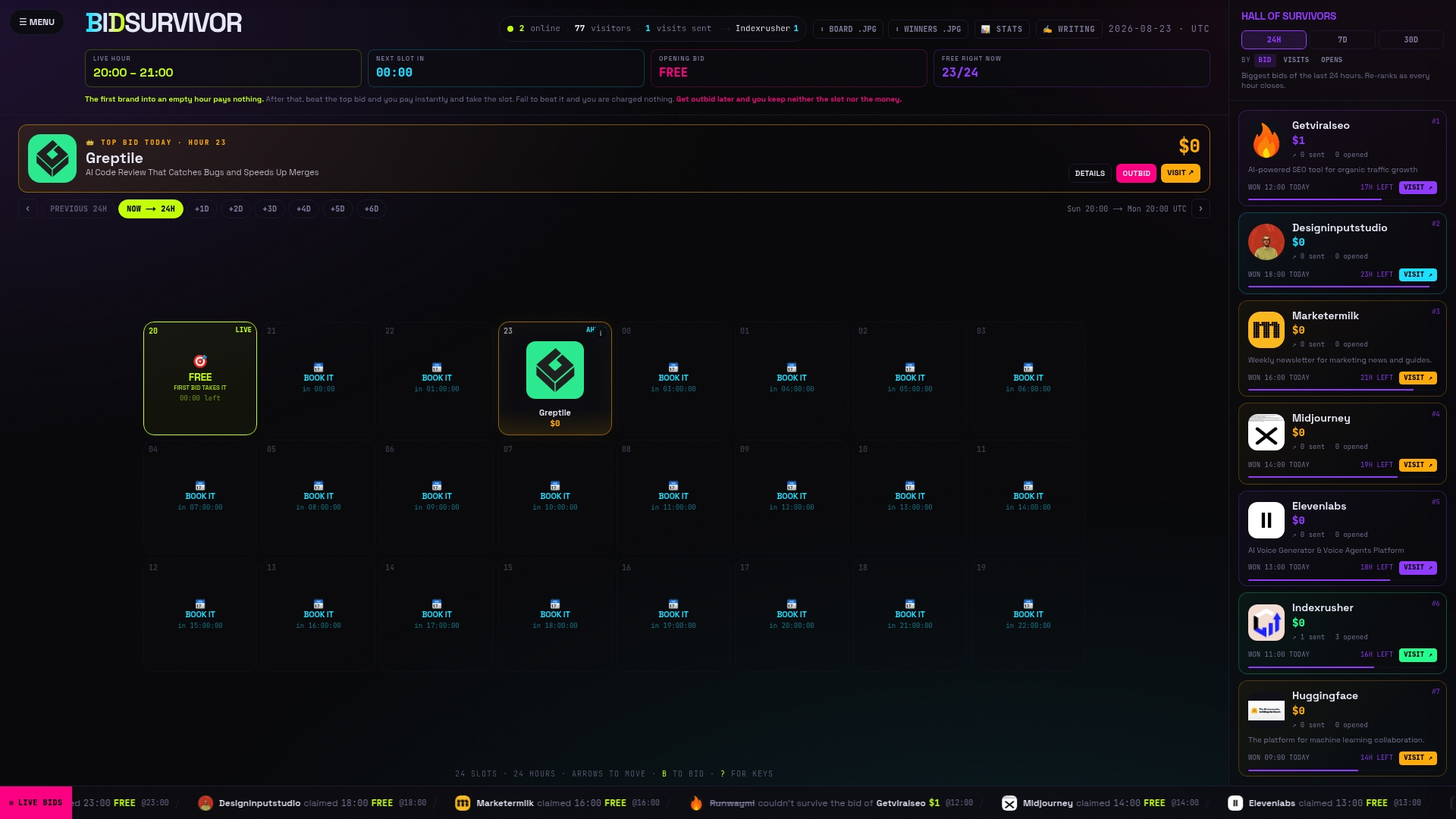
If you're a marketer who wants to see what performance-based ad buying looks like without the opacity of a traditional exchange, an open hourly slot costs nothing to claim, and an occupied one just requires beating the standing bid from a $1 floor. Check the current board and pricing example to see exactly what a winning slot's traffic numbers look like before you commit a single dollar.
Sources
For readers who want to go past this overview, these are the primary technical and regulatory sources worth reading directly:
- Real-time bidding | Google for Developers
- Real-time bidding for online advertising: measurement and analysis
- About Prebid.js for Header Bidding
- Unpacking real-time bidding through FTC’s case: Mobilewalla
- Real-time bidding